
How is transportation management better with a network?
That is one of the questions we are exploring as part of our “Better With A Network” research initiative, which I wrote about recently in “Better With A Network: A Research Initiative 22 Years In The Making.”
Freight procurement is a clear example of where “the power of the network” is evident.
“For a company of our scale, managing numerous mini bids is a complex and time-consuming endeavor,” said Emily Conner, senior director of transportation purchases, North America Market Operations at Procter & Gamble, as quoted in a recent Trimble press release about P&G being the first Trimble Freight Marketplace shipper in North America. “The platform saves us time while enabling us to discover new, reliable carrier partners and strengthen our relationships with existing partners.”
As highlighted in the press release, “Freight Marketplace has been available in Europe since 2023 via the Transporeon platform [with over 7,000 carriers, shippers and brokers participating]. Now, P&G joins a growing network of more than 400 carriers on Freight Marketplace in North America.”
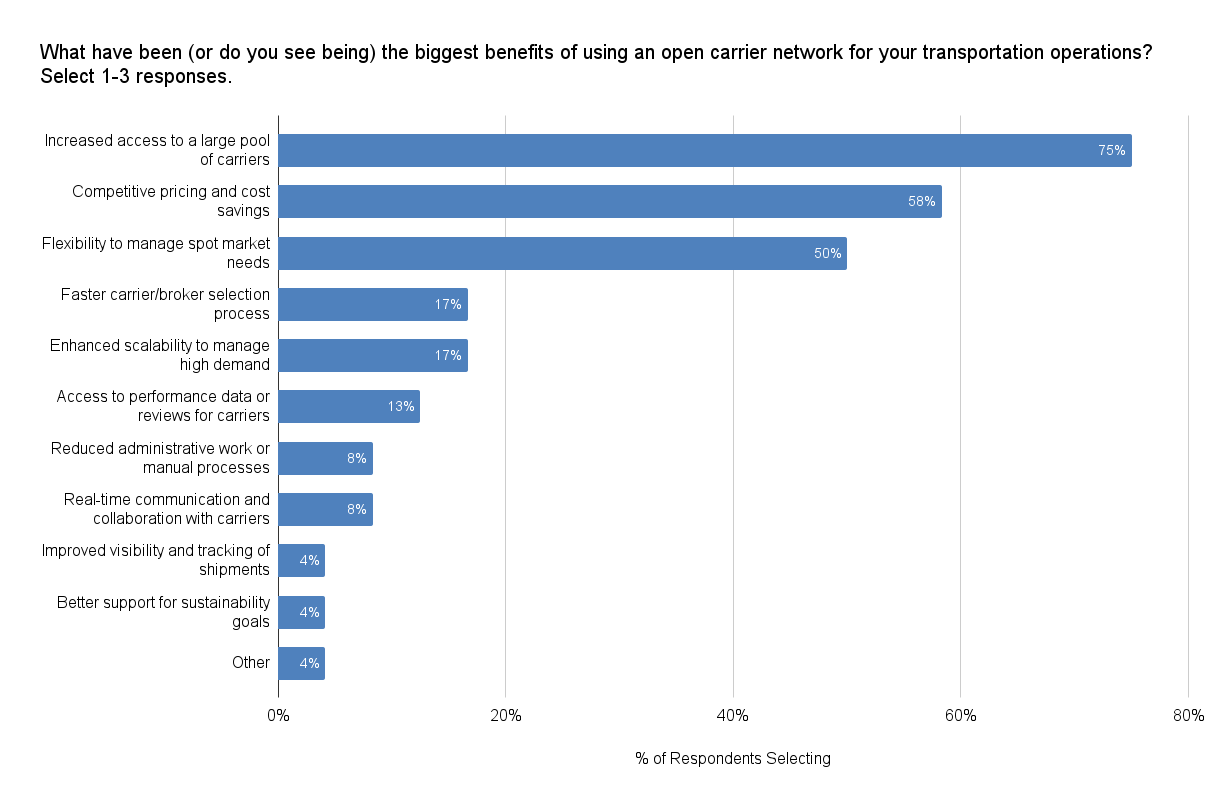
Emily Conner’s comment aligns with our research results. In February 2025, we asked members of our Indago supply chain research community — who are all supply chain and logistics executives from manufacturing, retail, and distribution companies — about the biggest benefits they have experienced (or would expect to experience) by plugging into a network of connected carriers and brokers. “Increased access to a large pool of carriers” topped the list of benefits, with 75% of the respondents selecting it. This was followed by “Competitive pricing and cost savings” (58%) and “Flexibility to meet spot market needs” (50%).
Over the years, we have conducted a lot of research on the “power of the network” as it relates to transportation procurement. Here are some posts related to the topic:
- Reimagining Transportation Procurement: Leveraging Data And Technology For Smarter Freight Decisions
- Data-Driven Decision Making: Autonomous Procurement
- You’re Already Using Open Networks — Why Not In Transportation Management?
- How Shippers Can Uplevel Their Real-Time Transportation Procurement Strategies
- How Technology Is Transforming Transportation Procurement
- We’re Not In 1980 Anymore: Time To Innovate Transportation Procurement
In general, here are the main benefits of utilizing a network-based transportation management platform for freight procurement:
- Access to a larger, more diverse community of carriers and brokers (both existing partners and potential new ones)
- Secure spot capacity more quickly and efficiently, especially during seasonal peaks and disruptions
- Potential to lower transportation costs through real-time, market-based pricing
- Optimize carrier selection and lane performance by using network-based analytics for both contract and spot procurement
- Streamline and automate load tendering, booking, and tracking
In a survey we conducted in October 2020, 91% of our Indago supply chain research community members either “Agreed” or “Strongly Agreed” that the time had come to transform the traditional transportation procurement process. It’s now almost 5 years later. Have you transformed the way you conduct freight procurement?
Here’s a quick way to know: Are you still emailing Excel spreadsheets back and forth to carriers? Are you still conducting one big annual procurement event and not doing mini-bids throughout the year to make adjustments to your routing guide as needed — that is, are you still taking a “set it and forget it” approach to your routing guide?
If you answered ‘Yes’ to either question, then you’re way behind the curve and you should put innovating your approach to transportation procurement on your priority list for 2026.