

The war with Iran — and its impact on fuel prices and supply chains — is dominating the headlines. There are also ongoing developments on the tariffs front. The Trump administration, for example, is imposing new tariffs on branded drugs from pharmaceutical companies, and it’s changing how tariffs on imported steel, aluminum, and copper are assessed.
But outside the spotlight (for now) is another trade-related development that could have equally significant supply chain implications: USMCA negotiations.
Talks to renew the US-Mexico-Canada Agreement have begun — at least between the U.S. and Mexico — and there’s considerable uncertainty about what will happen in the weeks ahead leading up to July 1, 2026.
What’s so important about that date?
As summarized in an article by the Center for Strategic & International Studies (CSIS):
“Under Article 34.7 of the USMCA, the three governments [U.S., Mexico, and Canada] must decide by July 1, 2026, whether to extend the agreement for another 16 years. If any party declines to confirm, the USMCA enters a cycle of annual reviews and, absent resolution, expires in 2036. July 1 is therefore not a deadline for completing negotiations. It is the point at which the clock either resets or starts running down. If the clock resets and the USMCA is renewed, with or without amendments, the same process will recur in 2032.”
In other words, July 1 isn’t a finish line — it’s an inflection point.
Leading up to that date, the U.S. and Mexico have begun discussions. But what about Canada?
“The review deadline for the Canada-United-States-Mexico-Agreement (CUSMA) is less than three months away, but it remains unclear where Canada stands at the negotiating table,” reported Jordan Gowling in a National Post article published April 2 (“Canada should expect ‘hostility’ with U.S. trade talks less than three months away, trade analysts say”).
Simply put, there is a high degree of uncertainty surrounding the fate of USMCA, with analysts outlining a wide range of possible outcomes.
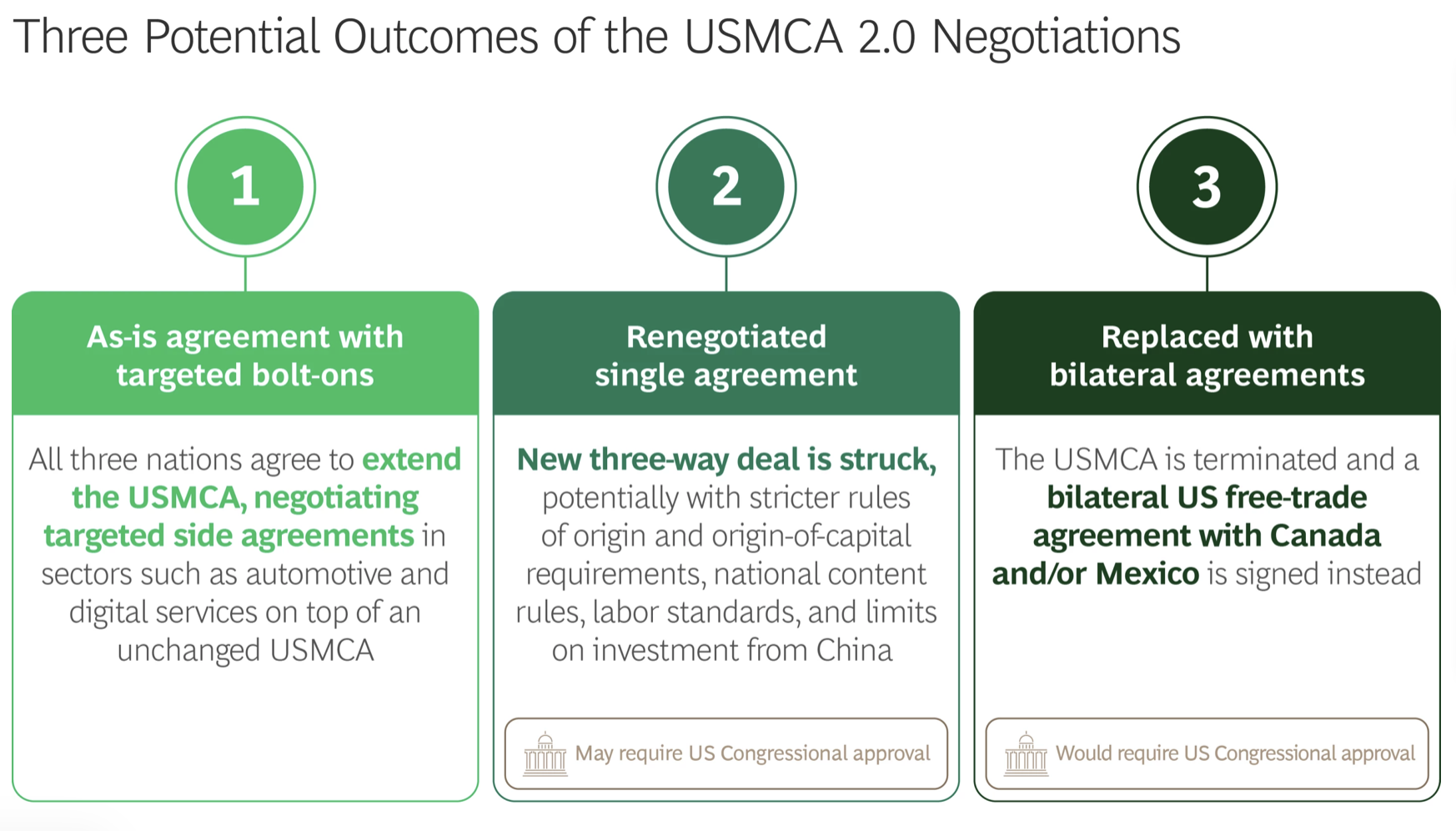
The Boston Consulting Group, for example, outlines three scenarios in a recent post titled “Preparing for a New Era in North American Trade”:
In a January 2026 brief, Oxford Economics provides four potential outcomes. Here is their worst-case scenario (which they believe has a 10% probability):
“One or more parties don’t confirm their desire to extend the USMCA in its current form, and instead back out of the agreement altogether. U.S. effective tariff rates on Canada and Mexico rise noticeably higher as the USMCA exemptions are completely removed. Trade policy uncertainty spikes in Q3 and remains permanently higher. While Mexico isn’t expected to retaliate, Canada would reimpose counter tariffs on U.S. goods.”
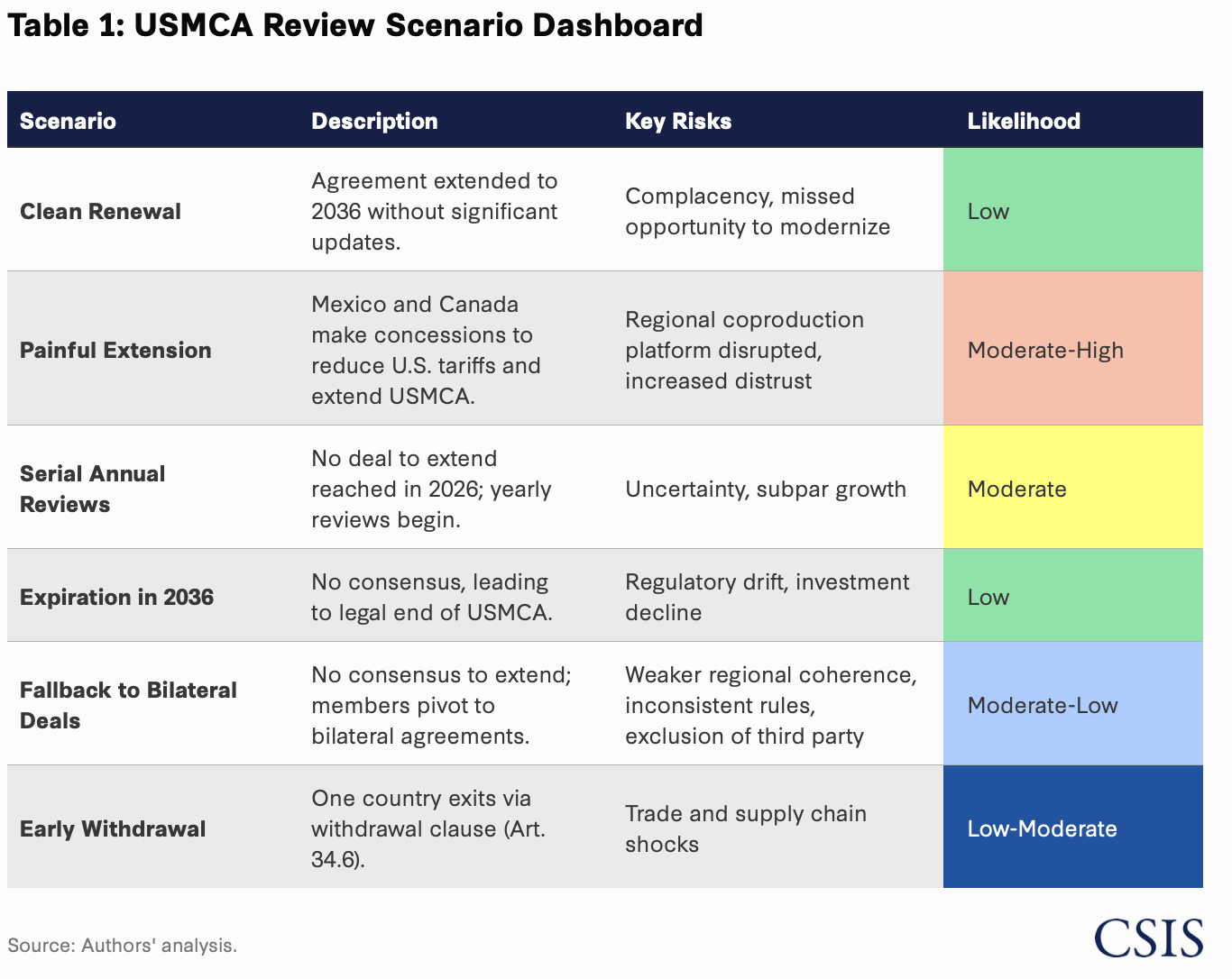
And CSIS outlines six scenarios based on its analysis:
So, what does this mean for supply chain and logistics leaders?
If your supply chain depends on USMCA — whether for sourcing, manufacturing, or cross-border transportation — this is not a “wait and see” moment. This is a “prepare and decide” moment.
The companies that will navigate this period most effectively won’t be the ones that predict the right scenario. They’ll be the ones that are right now (among other things):
- Stress-testing their network against different tariff and trade policy outcomes
- Understanding how quickly they can shift sourcing, routing, or inventory positioning if conditions change
- Aligning internally (and with partners) on decision triggers and contingency plans
Whether July 1 resets the clock or starts it running down, what matters most isn’t predicting the outcome, but being prepared to act when clarity arrives.