

Editor’s Note: The following is an excerpt from the recently published research report “From Managing Shipments to Orchestrating Networks: What Will Separate Transportation Leaders from the Rest?” Conducted by Adelante SCM and commissioned by Alpega, the research examines the capabilities, technologies, and practices that will distinguish transportation leaders over the next three to five years, based on surveys of shippers, carriers, and logistics service providers. To access the complete findings, download the full report.
Transportation management is becoming more complex and dynamic. Market volatility, rising customer expectations, labor challenges, geopolitical uncertainty, and rapid advances in technology are reshaping how freight is planned, executed, and managed.
Against this backdrop, what will separate transportation leaders from the rest over the next three to five years?
To explore this question, Adelante SCM and Alpega surveyed 56 supply chain and logistics executives from manufacturing, retail, and distribution companies, as well as 239 carriers and logistics service providers (LSPs) from across Europe. While the two surveys differ in size and respondent composition, together they provide valuable perspectives from both sides of the transportation ecosystem.
The results reveal strong alignment on where the industry is headed. Both groups envision a future defined by greater connectivity, visibility, automation, collaboration, and data-driven decision-making. More importantly, respondents repeatedly described a shift from managing transportation activities to orchestrating transportation networks, a theme that emerged consistently across both the quantitative and qualitative findings.
Trust Is Earned Through Execution
Trust emerged as a common theme across both shippers and carriers/LSPs.
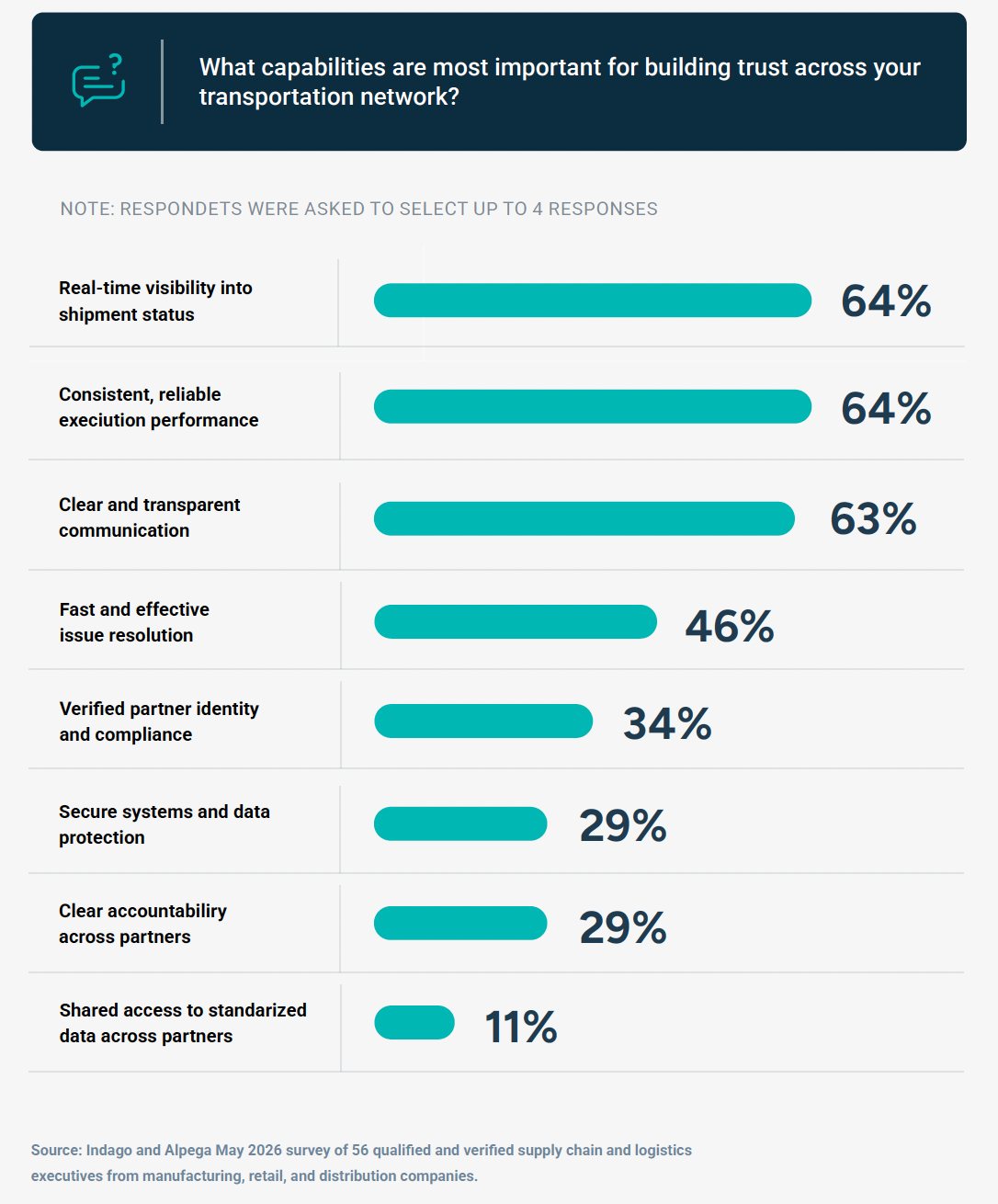
Among shippers, the most important capabilities for building trust are real-time visibility into shipment status (64%), consistent execution performance (64%), and clear, transparent communication (63%).
Among carriers and LSPs, trust is built primarily through reliable on-time service performance (49%), fast and effective issue resolution (43%), proactive communication about delays and issues (40%), and fair and transparent pricing (36%).
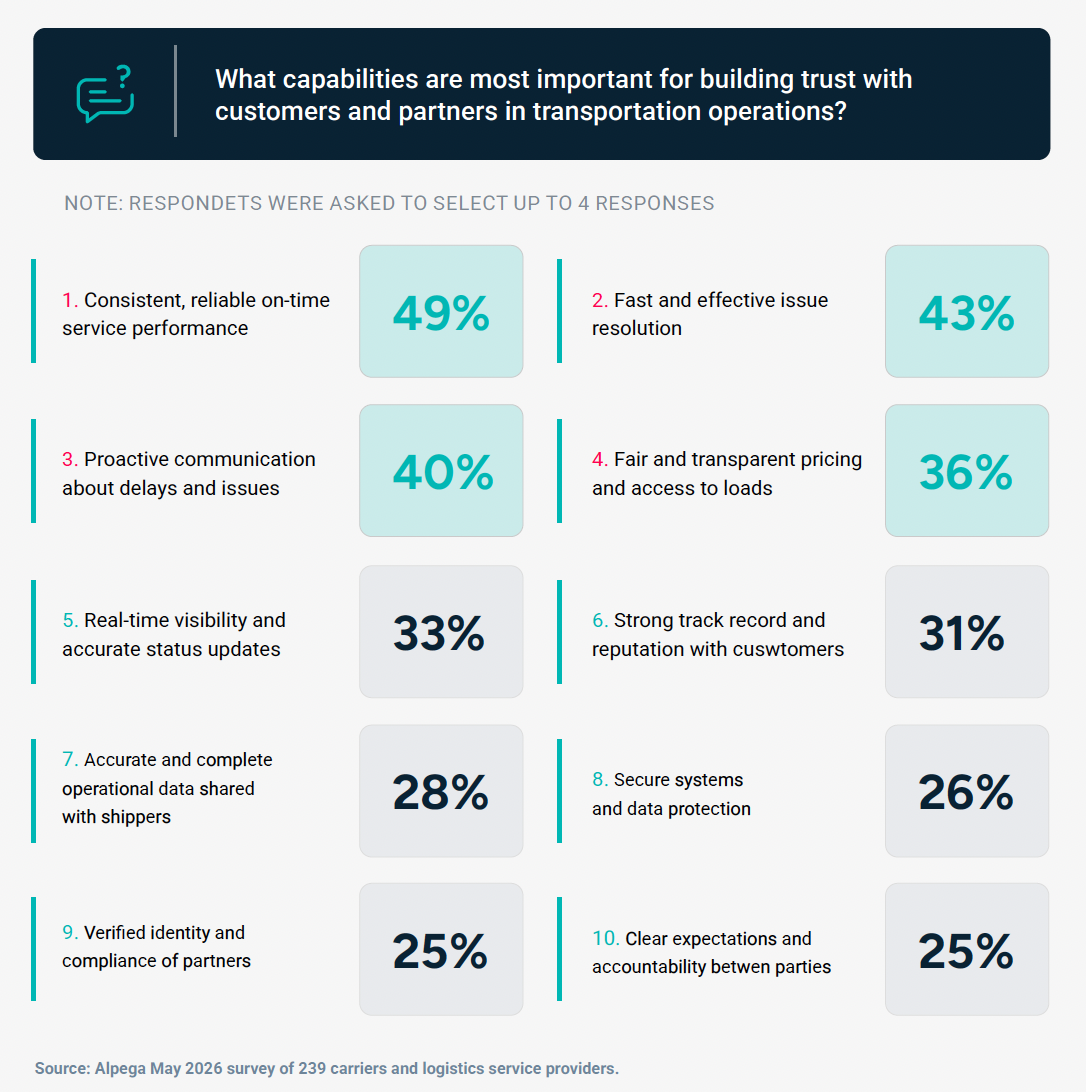
While the specific rankings differ, the underlying message is consistent: trust is operational. It is built through reliable execution, proactive communication, responsiveness, and transparency.
For carriers and LSPs, trust often comes down to keeping customers informed and eliminating uncertainty. As one respondent summarized: “Real-time status updates, integrated systems, and clear, timely communication.”
Shippers expressed a similar view. One respondent noted that transparent data enables companies to manage disruptions proactively and maintain product availability.
These responses reinforce a broader theme that emerged across both shippers and carriers/LSPs: trust is built when organizations consistently deliver on their commitments, especially when disruptions occur. On-time performance, proactive communication, appointment adherence, and effective response to disruptions all provide signals about which partners can be relied upon.
Many of these signals only become visible over time and across large numbers of transactions. This is one reason trust is increasingly linked to network performance. Network-based platforms can help by providing broader visibility into these patterns across transportation ecosystems, enabling organizations to make more informed decisions about who they work with and how they manage risk. Ultimately, however, while technology can support trust, it cannot create it. Trust is earned through consistent execution.
For additional insights from the research, including what will separate transportation leaders from the rest, why network performance is becoming a competitive advantage, the growing role of AI, and five recommended actions for transportation leaders, please download the full report.