

Editor’s Note: The following is an excerpt of a research report published this week, “Freight Forwarding at a Crossroads: Preparing for 2026 and Beyond.” The research, conducted by Adelante SCM and commissioned by Magaya, aimed to understand the adjustments, innovations, and strategic bets freight forwarders are making to stay ahead in an increasingly complex and dynamic market. The report includes data and insights from a survey conducted in July 2025 with 110 qualified and verified freight forwarders and logistics service providers. Please download the full report for all the research results, and register for the LinkedIn Live event on October 14 at 2:00 pm ET where Adrian Gonzalez and Magaya executives and customers will analyze and discuss the findings of the report.
The famous management consultant and author Peter Drucker once said, “The greatest danger in times of turbulence is not the turbulence — it is to act with yesterday’s logic.”
So far, 2025 has been a relatively turbulent year for freight forwarders and logistics service providers. The tariff war, which began in January after the election of Donald Trump as U.S. president, has brought added risk, uncertainty, and costs to global trade operations. What makes it especially challenging is the ongoing changes, with tariffs increased, decreased, added, or eliminated, almost on a daily basis.
In addition, effective August 29, 2025, the de minimis exemption for commercial shipments will be suspended. Per the Executive Order issued in July 30, “imported goods sent through means other than the international postal network that are valued at or under $800 and that would otherwise qualify for the de minimis exemption will be subject to all applicable duties.” The de minimis exemption was already eliminated for shipments from China and Hong Kong in May 2025.
What will happen next on the tariffs and regulatory compliance fronts? Nobody knows for sure, which is what makes operating in this highly uncertain and ever-changing global trade environment so challenging for freight forwarders and shippers alike.
Compounding this turbulence is the rapid changes happening on the technology front — specifically, with Artificial Intelligence (AI). “Artificial intelligence is going to replace literally half of all white-collar workers in the U.S.,” Ford CEO Jim Farley said in June 2025 at the Aspen Ideas Festival, as reported in a Wall Street Journal article titled, “CEOs Start Saying the Quiet Part Out Loud: AI Will Wipe Out Jobs.”
Needless to say, with headlines and comments like these, AI is creating a lot of fear and uncertainty amongst workers, with many people viewing it as a threat to their jobs.
How much of the work done today by freight forwarding professionals will be handed over to AI agents that can analyze situations, develop strategies, and execute tasks independently? And how quickly will this happen?
Again, it is hard to know for sure. What we do know, based on findings from “The State of Digitization in Freight Forwarding 2025” report published in February 2025, is that 18% of the freight forwarders and logistics service providers surveyed in November 2024 said they were “Very likely” to invest in AI in 2025 and 33% said they were “Somewhat likely.”
Back to the Drucker quote, the greatest danger freight forwarders face today is to respond to all of this change and uncertainty with the same logic (and the same skillsets, processes, and technologies) as yesterday.
In light of these trends, Adelante SCM and Magaya surveyed 110 freight forwarders and logistics service providers in early July 2025. The goal was to understand the adjustments, innovations, and strategic bets freight forwarders are making to stay ahead in this increasingly complex and dynamic market. Here is one of the key takeaways from the research results.
Biggest AI Challenge: Lack of Internal Expertise or Understanding
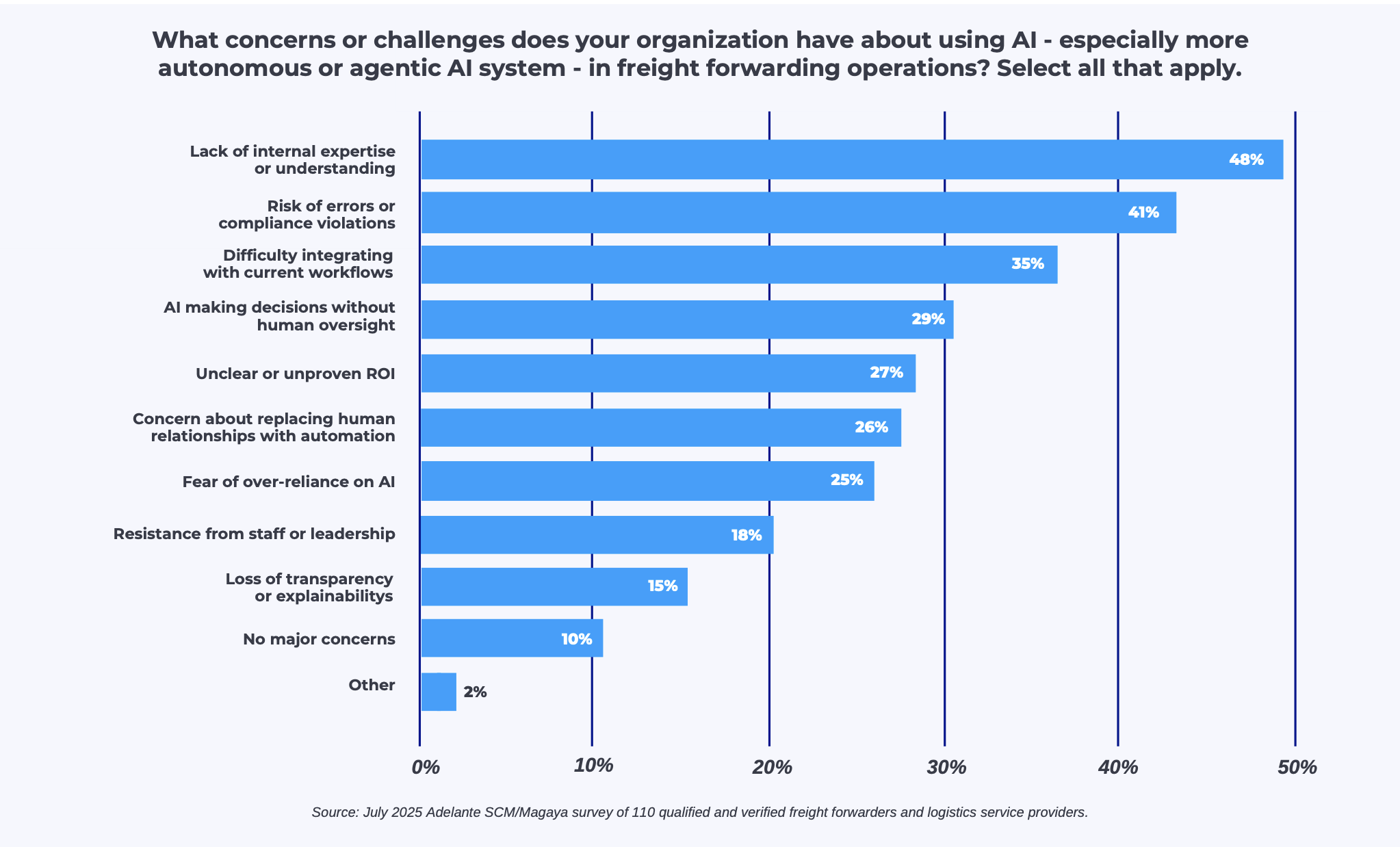
For small and larger freight forwarders alike, the biggest concern or challenge their organizations have about using AI — especially more autonomous or agentic AI systems — is “Lack of internal expertise or understanding,” which was selected by 48% of the respondents. This points back to the earlier discussion [in the report] about the need for freight forwarders to upskill/reskill their employees. “Risk of errors or compliance violations” (41%) and “Difficulty integrating with current workflows” (35%) also ranked high.
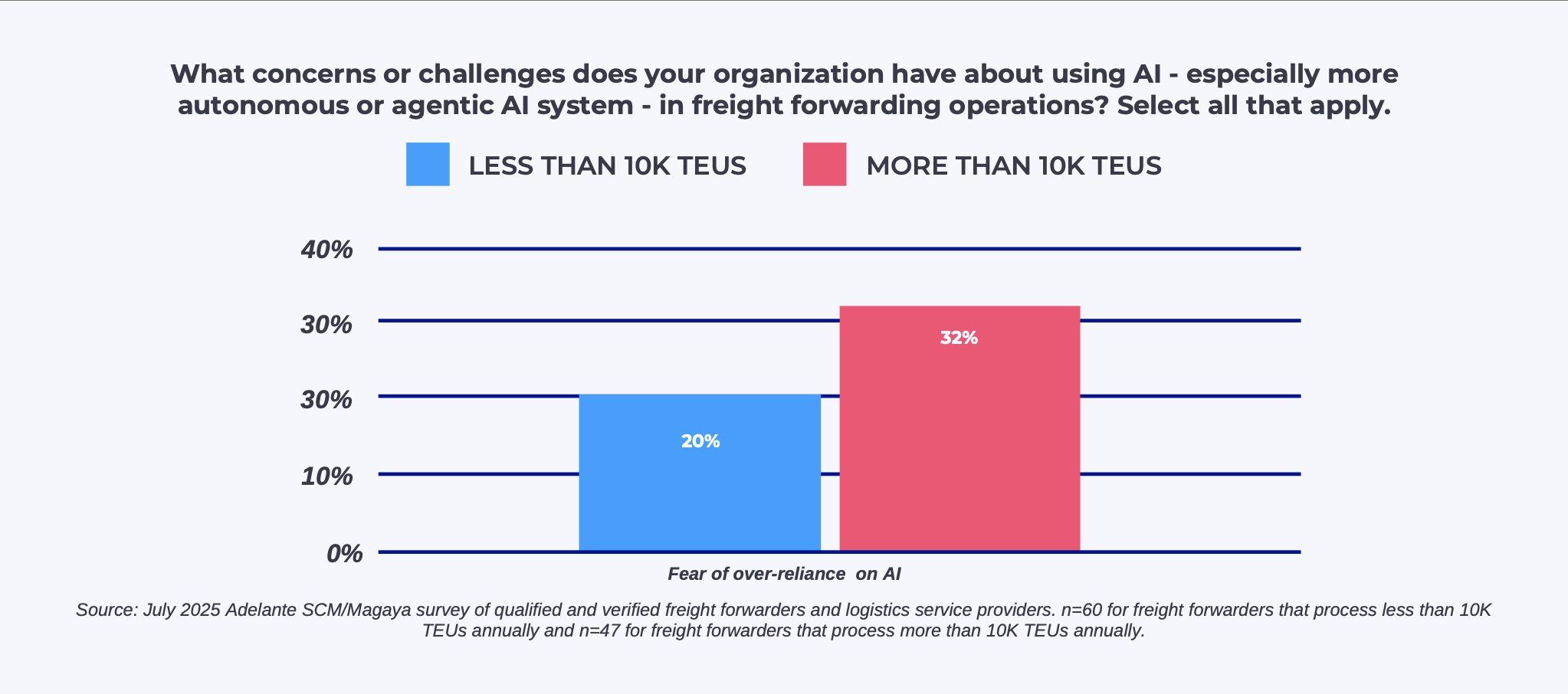
The survey results also showed that larger forwarders are significantly more concerned about over-reliance on AI than small forwarders (32% vs. 20%). This may reflect their deeper experimentation with AI and a clearer understanding of its risks. Small forwarders, by contrast, may lack the maturity in AI deployment to see these risks yet — pointing to a gap in readiness and awareness.
Freight forwarders, therefore, need to close the “AI readiness” gap. They need to upskill their teams on AI fundamentals and start with low-risk use cases to build internal capabilities and trust.
For additional insights from the research, including the actions freight forwarders are taking to modernize their operations and better meet shipper expectations in 2026 and beyond, please download the full report and register for the LinkedIn Live event on October 14th at 2:00 pm ET.