

What happens in Vegas stays in Vegas — or so the saying goes. But I’m going to break that rule and share some takeaways from SAP Supply Chain Connect 2025, which was held last month in Sin City.
One of the highlights for me took place on the Strip, before the conference even began. I was on a walk after dinner when I saw “Unbreakable Supply Chain” projected on The Sphere. It was so big, you couldn’t miss it. It made me think: we’ve come a long way since I started as an industry analyst 26 years ago, when many (if not most) CEOs had limited knowledge about supply chain management, and the general public knew even less about it (basically zero). Now, thanks in large part to the Covid pandemic and the ongoing tariff wars, “supply chain” is in bright lights on the marquee.

Yes, we’ve come a long way, baby! But there’s still a lot of work to do and more road to cover, because in a world of constant change and uncertainty, there’s no end to the journey.
Moving Up the Supply Chain Logistics Maturity Model
Speaking of journeys, I participated in a pre-conference workshop for a select group of supply chain and logistics executives. I led a discussion centered on the Supply Chain Logistics Maturity Model, based on research we conducted on behalf of SAP earlier this year. Check out the post I wrote in June about it — and download the full report for all the details.
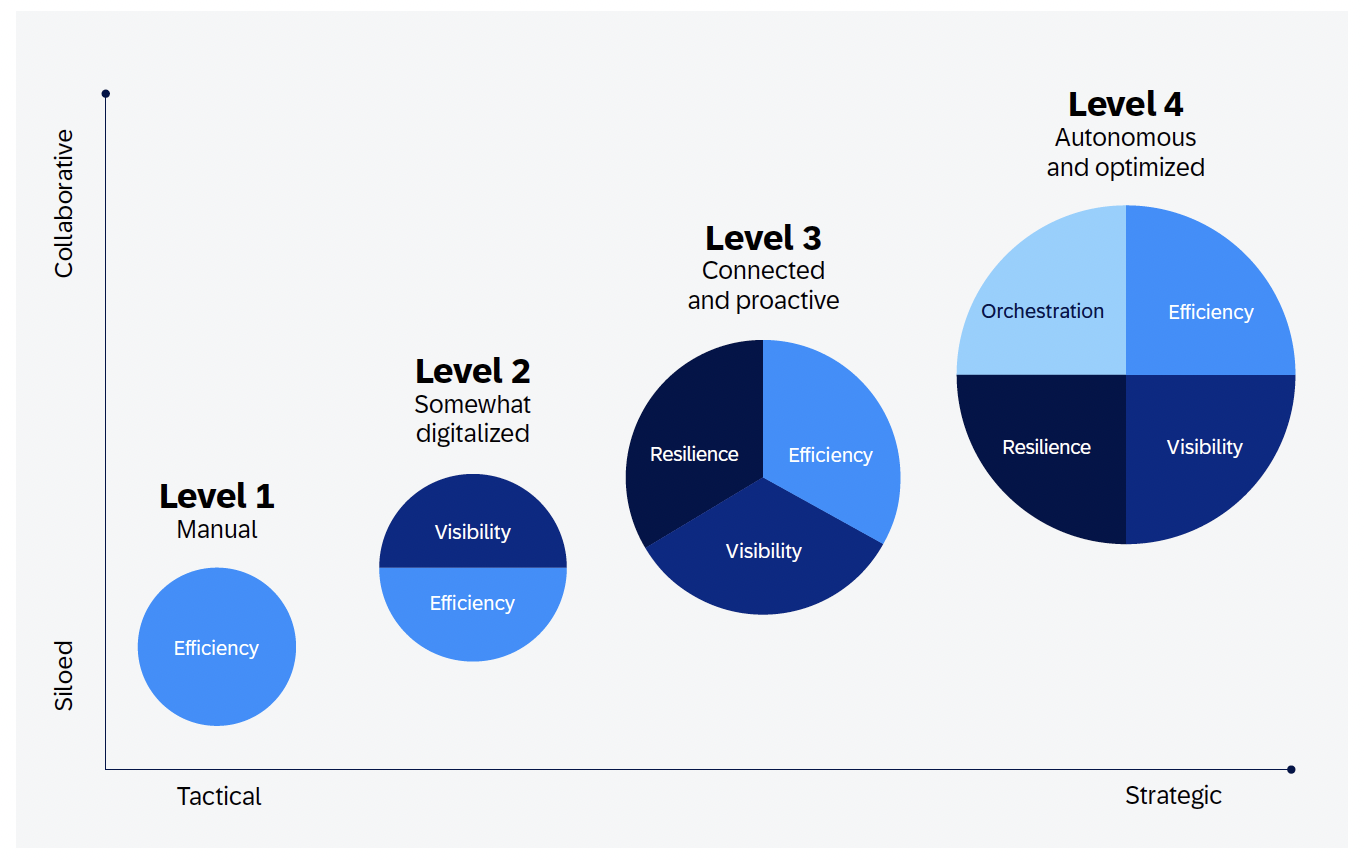
It was a productive and informative conversation. In short, the session reinforced the research findings — that is, most companies are somewhere between Level 2 and Level 3. This aligns with research we conducted with our Indago supply chain research community in September 2024.
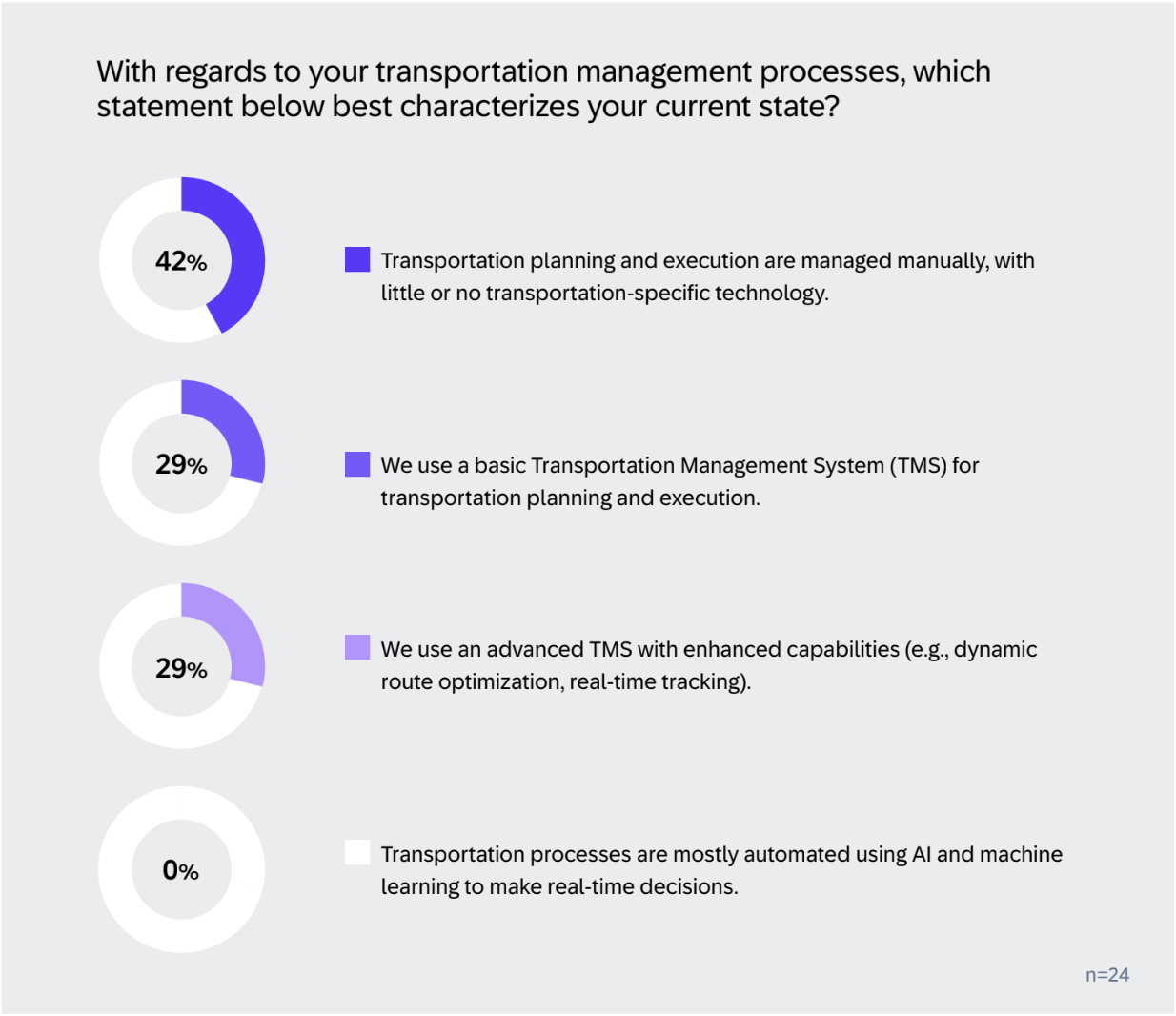
We asked respondents — all qualified and verified supply chain and logistics executives from manufacturing, retail, and distribution companies — to select the phrase that best characterizes their transportation management processes. More than half selected either “We use a basic Transportation Management System (TMS) for transportation planning and execution” (28%) or “We use an advanced TMS with enhanced capabilities” (32%). None of the respondents selected “Transportation processes are mostly automated using AI and machine learning to make real-time decisions.”
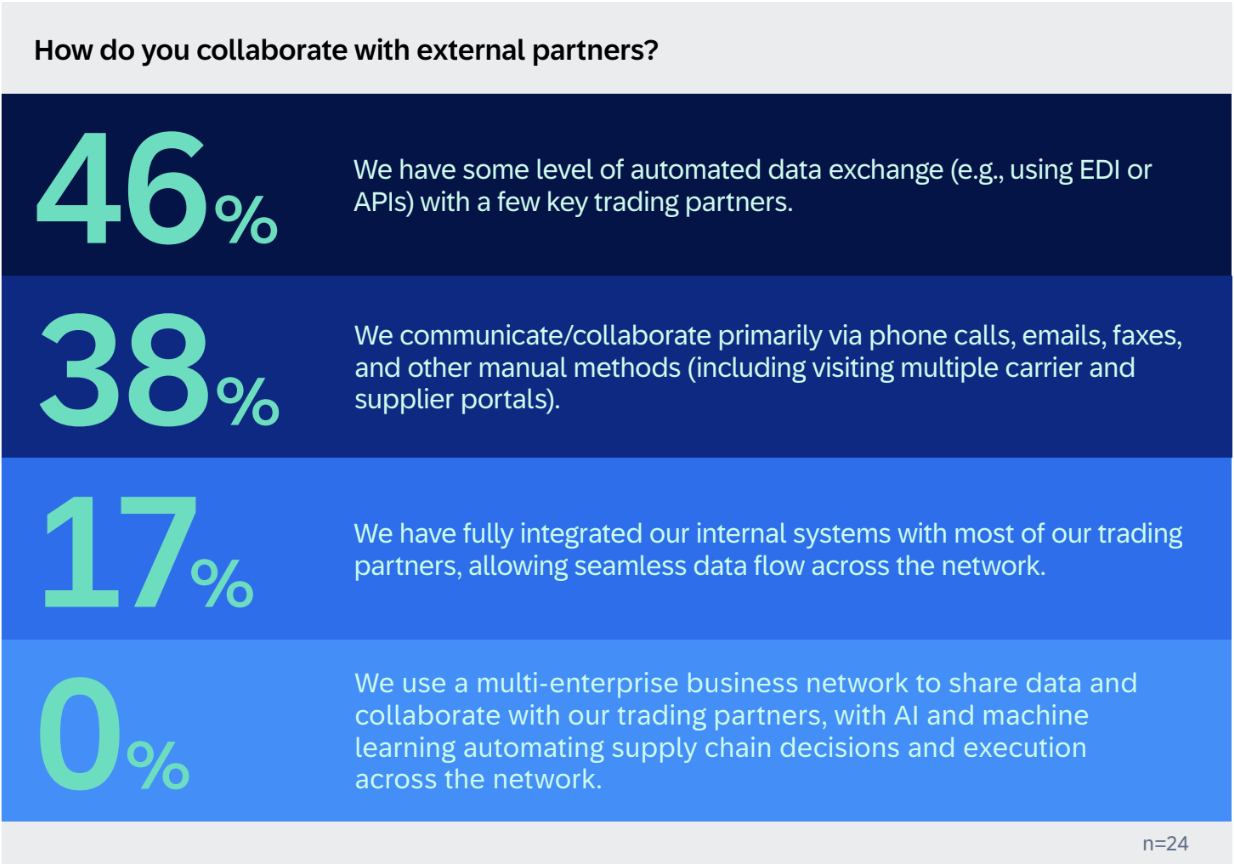
Similarly, when asked how they communicate and collaborate with trading partners, the majority selected either “We have some level of automated data exchange (e.g., using EDI or APIs) with a few key trading partners” (44%) or “We have fully integrated our internal systems with most of our trading partners, allowing seamless data flow across the network” (20%). None selected “We use a multi-enterprise business network to share data and collaborate with our trading partners, with AI and machine learning automating supply chain decisions and execution across the network.”
The bottom line: most companies are making progress, but there’s still a long climb to true digital maturity.
What’s Holding Companies Back?
The workshop attendees discussed a range of familiar barriers, such as change management, budget constraints, and competing priorities. But one challenge everyone agreed on can be summed up this way: “We still have data issues, and because much of the data we need resides outside our company — at our suppliers, customers, and logistics service providers — we need to integrate, communicate, and collaborate more effectively with our trading partners.”
Interestingly, that very challenge — data integration and collaboration — was a key theme throughout the conference sessions and solution announcements.
The Power of a Seamless App-Data-AI Flywheel
Muhammad Alam, Member of the Executive Board of SAP SE, Product & Engineering, opened his keynote with a simple but powerful idea: “We believe a seamless app, data, and AI flywheel creates the highest value.”
Many companies, he cautioned, still treat these elements as separate layers — adding AI on top of existing systems or isolating data into standalone platforms. That fragmented approach leads to “significant additional investments” and “opportunity costs in terms of reduced accuracy and reduced adoption.”
With a seamless flywheel, however, organizations benefit from “increased accuracy and lower hallucinations.”Adoption also improves because “AI is natively available in the applications people work with every day.”
Another key message: “AI with the broadest context provides the deepest value.” True business value comes when AI understands relationships across all domains — procurement, finance, HR, manufacturing, and supply chain — while also being deeply process- and role-aware. This, Alam said, enables companies to achieve “global maxima and not just siloed local optimums.”
Finally, Alam predicted that “AI will fundamentally reinvent business applications.” SAP, he said, sees five patterns of AI-driven innovation that define this new era:
- Seamlessly embedded AI and agentic experiences that enhance decision-making within daily workflows
- Agent-driven autonomous execution, where AI agents perform actions across multiple systems
- AI-native applications built from the ground up for the AI era, where “AI and the app are indistinguishable”
- App-less experiences, in which conversational AI replaces traditional screens and menus
- No-app experiences, where AI dynamically generates applications in real time using “vibe coding”
As Alam put it, this evolution will transform not only how enterprise systems are architected, but also how people interact with them. If the shift from green screens to GUIs was revolutionary, this next wave will be even more dramatic and far more empowering.
SAP Logistics Management: Bringing Visibility to the “Digital Deadzones”
At the conference, SAP announced several new supply chain solutions and enhancements, including Supply Chain Orchestration, new Joule Agents, updates to SAP Business Network, and advanced AI capabilities for SAP Integrated Business Planning (SAP IBP). I don’t have the time or space to cover them all here, so I encourage you to read the press release for details.
One new solution worth highlighting, though, is SAP Logistics Management.
This solution targets small, remote, and satellite logistics operations. These are the supply chain nodes that are often too complex for spreadsheets but too small to justify a full-scale warehouse management or transportation management system. As Till Dengel, who leads product marketing for SAP’s logistics business, explained on a recent episode of The Future of Supply Chain, the goal is simple: “To bring together warehousing, transportation, and a built-in carrier network for smaller sites that still need to operate with the same visibility and control as larger ones.”
For many companies, these smaller sites are digital deadzones, contributing to the data gaps and visibility blind spots mentioned by the workshop attendees. This issue is growing as retailers, distributors, and manufacturers add regional facilities to speed up delivery and improve service. SAP Logistics Management aims to close that gap. While pricing details weren’t discussed, SAP appears to be taking a low-cost, scalable approach to encourage adoption.
One of the first companies testing the solution is Döhler, a global producer of natural ingredients and ingredient solutions for the food and beverage industry. During a recent SAP Expert Talk episode, Srikanth Velagapudi, Head of IT Logistics at Döhler, shared the company’s early experience:
“At Döhler, we have production sites, warehouses that serve as distribution centers, and technical warehouses. We see SAP Logistics Management as a product that fits well into our sampling warehouses, where we store samples, as well as our technical warehouses that support production lines.
“It’s also suitable for our smaller distribution centers where we store finished goods and raw materials. These facilities are strong candidates for the solution.
“We can use the solution for tracking and tracing inventory… SAP Logistics Management helps us reduce manual errors when managing stored products and provides visibility into which warehouses contain which quantities of samples or technical parts.
“For example, before peak seasons, we can better plan what technical parts we’ll need and order them upfront. So, for tracking, visibility, and inventory accuracy, we see SAP Logistics Management as a valuable solution.”
I encourage you to watch the full episode, but the takeaway is clear: Döhler’s early results show how SAP Logistics Management can digitize smaller warehouse operations, improve visibility, and reduce manual effort while extending the reach of S/4HANA into parts of the supply chain that were previously offline.
Final Thoughts
Going back to the flywheel and the pre-conference workshop: Even though AI is getting most of the attention today, the role of data remains the most critical piece of the puzzle.
Of course, this has always been the case (see my May 2014 post, “The Big (Crappy) Data Problem in Supply Chain Management”). We’ve gone from data warehouses and data lakes to newer platforms like Databricks and Snowflake. And back in February 2025, in partnership with Databricks, SAP announced SAP Business Data Cloud, a solution “that unifies all SAP and third-party data throughout an organization, providing the trusted data foundation organizations need to make more impactful decisions and foster reliable AI.”
I’ll admit, I haven’t paid much attention to this topic in the past — it’s a bit too IT-centric for me — but now I’m rethinking that. Because as boring as this topic might sound, all the promises of AI and next-generation business applications depend on it.