
It’s the first day of December, which means we have entered the final month of 2025. What will the “Word of the Year” be in supply chain management? It’s no contest: tariffs.
On November 5th, the U.S. Supreme Court heard oral arguments “in a pair of challenges to President Donald Trump’s power to impose sweeping tariffs on virtually all goods imported into the United States.” Depending on the outcome, billions of dollars in tariffs could be upheld or rolled back, with far-reaching implications for importers, exporters, and supply chain strategies.
In short, tariffs will continue to play a significant role in 2026 too.
Last month, we conducted a survey with members of our Indago supply chain research community to understand how supply chain and logistics executives are viewing the potential impacts, risks, and opportunities related to this upcoming Supreme Court decision. Below are some highlights from the research.
The Outcome of Supreme Court Case Will Be Impactful
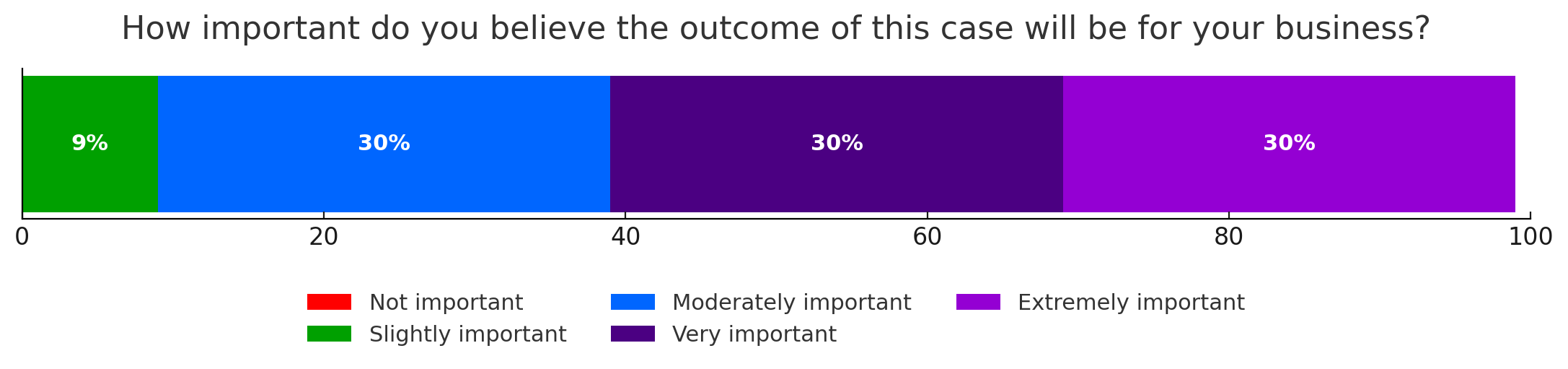
Supply chain and logistics executives overwhelmingly believe the Supreme Court’s decision will have meaningful business implications. A combined 90% rated the case as moderately, very, or extremely important.
Respondents highlighted several reasons for this heightened concern, including unpredictability, operational turmoil, and broader geopolitical dynamics:
- “A few thoughts come to mind — disruption, unrest, random, impactful…no predictability.”
- “Either way, there will be upheaval.”
- “Regardless of the outcome… we are going to be tossed about like a cork in the ocean for the foreseeable future.”
The comments reflect not just anxiety about tariff costs themselves, but the instability created by shifting trade policy. Even among respondents who aren’t strongly affected, there is a desire for fewer abrupt changes:
“This does not have a significant impact on our business either way. However, we would prefer to see fewer changes to tariffs.”
Overall, executives see the ruling as a bellwether for future trade governance and a potential signal of how predictable (or unpredictable) tariff policy will be going forward.
If the Tariffs Are Rolled Back or Reduced
The clearest takeaway: companies would move quickly to recover past tariff payments, with 61% indicating they would pursue refunds. For some businesses, this represents a substantial liquidity opportunity: “The biggest opportunity for us would be…to receive refunds. This would be a good infusion of cash to reinvest in growth.”
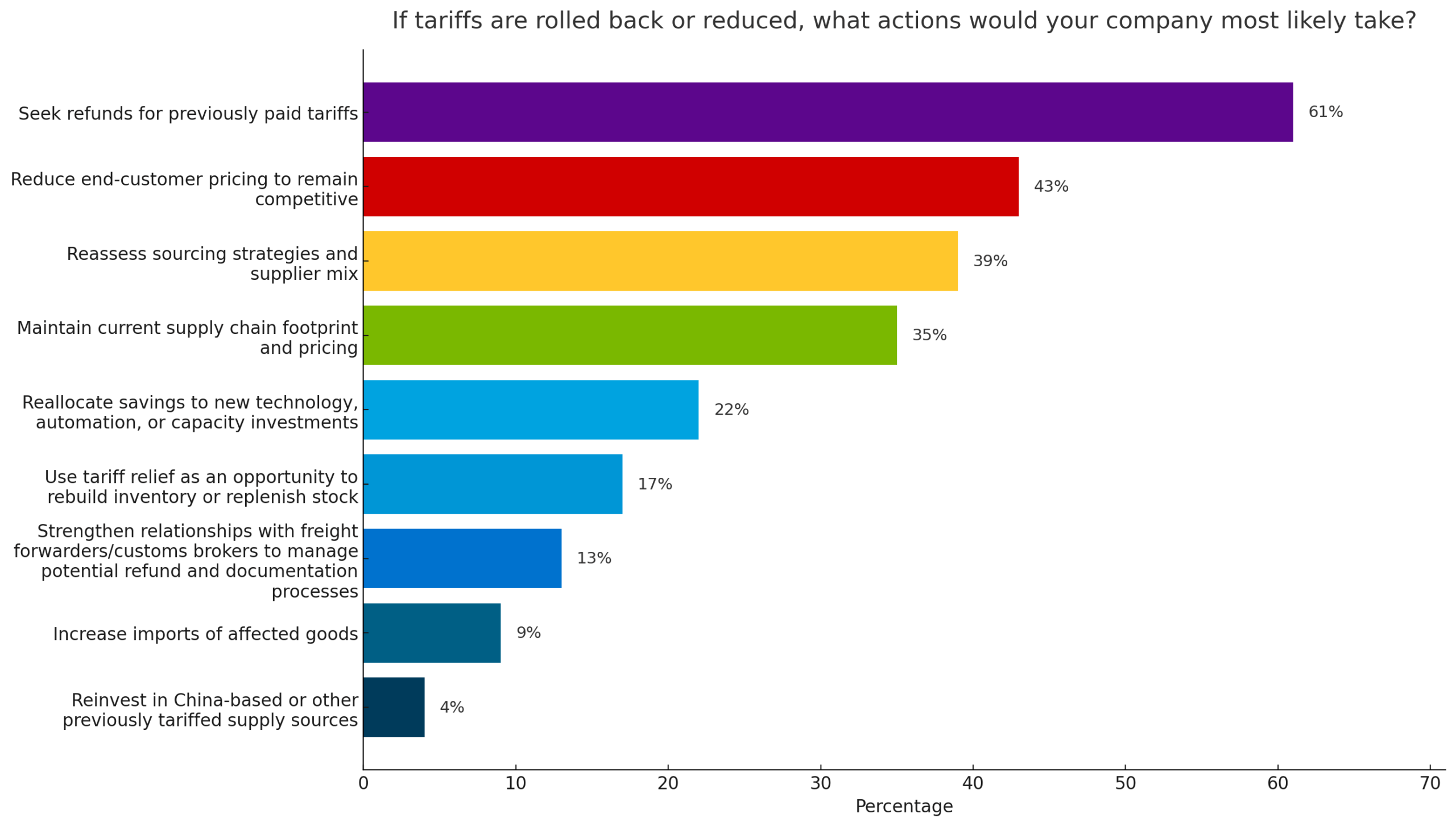
Secondarily, companies expect to adjust pricing and sourcing strategies:
- 43% would reduce end-customer pricing
- 39% would reassess sourcing
- 35% would explore inventory rebuilding
- 22% would reinvest savings in technology or capacity
Several respondents emphasized that while refunds are welcomed, tariff policy is only one factor influencing sourcing decisions. Some have already diversified or adapted their networks: “We’ve already resourced a lot of products outside of China and are dealing with the tariffs as they lie today.”
Others noted structural realities, such as dependence on China for unique materials, that limit optionality even if tariffs are removed: “We really don’t have options to pull our supply chain out of China… They are the #1 supplier of [our raw material]. We have brokers who can help file refunds, but the sourcing doesn’t change.”
In short, tariff relief would unlock near-term savings, but not necessarily reverse longer-term sourcing shifts already underway.
How prepared is your company to pursue potential tariffs refunds? If the Supreme Court upholds the tariffs, what actions would your company most likely take?
We asked our Indago members those questions too. Members can download the report for all the research findings.
What about you? What do you see as the biggest risks or opportunities for supply chains depending on how the Supreme Court rules? Post a comment and share your perspective!
It’s important to note, however, that a ruling against the Trump administration does not necessarily mean an end to the tariffs. It just means it can’t use the International Emergency Economic Powers Act (IEEPA) as a justification. But it can use other statutes that would be on more solid legal ground, such as Section 232 (for national-security reasons), Section 301 (to retaliate against unfair trade practices), and Section 201 (to stop import surges).
The truth is that regardless of what happens at the Supreme Court, tariffs ain’t going away in 2026 — and it may repeat as “Word of the Year” next year.
Join Our Supply Chain Research Community Today!
If you’re a supply chain or logistics practitioner from a MANUFACTURING, RETAIL, or DISTRIBUTION company and you’re interested in learning from your peers, I encourage you to learn more about Indago and join our research community. It is confidential, there is no cost to join and the time commitment is minimal (2-4 minutes per week) — plus your participation will help support charitable causes like Breakthrough T1D, American Logistics Aid Network, American Cancer Society, Feeding America, and Make-A-Wish.