

What is the biggest risk facing logistics operations today?
You can probably come up with a long list — everything from carrier bankruptcies to ports shutting down due to labor issues or geopolitical conflicts — but high up on the list, if not topping it, is cyberattacks.
“Cyberattacks on logistics have skyrocketed in recent years,” according to the 2026 Annual Supply Chain Risk Report published by Everstream Analytics. “In 2021, Everstream Analytics reported 20 incidents. Between then and 2025, there has been a 965% increase in attacks targeting logistics.”
The report adds that 2025 emerged “as a watershed moment for cyberattacks on logistics. Attacks on logistics, including carriers, 3PLs and other providers, increased from 132 to 213 incidents in 2025 — a 61% surge.”
What makes this risk particularly challenging is that “organizations have little control over the cybersecurity of third-party logistics providers, carriers, and the airport or maritime facilities upon which their operations depend. This lack of oversight, along with the ability to upend multiple organizations at the same time, is why cyberattacks on logistics are a critical vulnerability.”
I’ve written extensively about the risk of cyberattacks on supply chain operations, most recently last June in UNFI: Another Reminder Of Cyberattack Risks On Supply Chains.
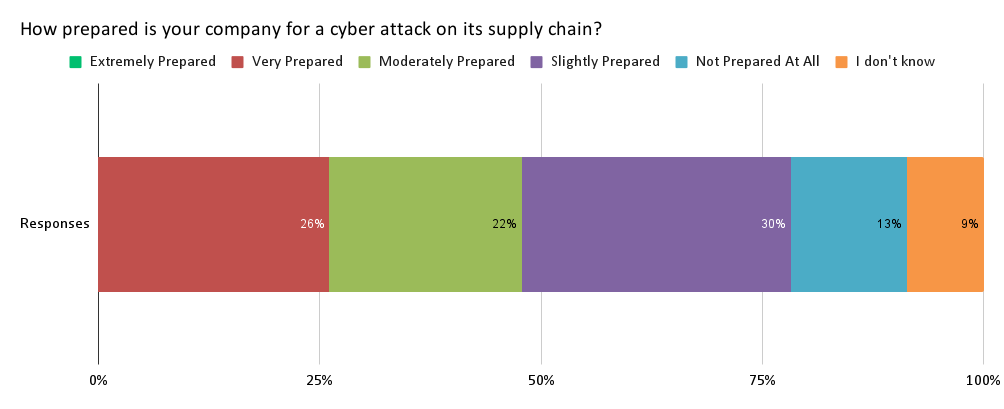
This is also a topic we have explored with our Indago supply chain research community. In January 2022, for example, we asked our Indago members — who are all supply chain and logistics executives from manufacturing, retail, and distribution companies — “How prepared is your company for a cyberattack on its supply chain?”
At the time, only 26% of our member respondents said their companies were “Very Prepared” for a cyberattack on their supply chains, while 43% said they were only “Slightly Prepared” (30%) or “Not prepared at all” (13%).
“No efforts are underway to head off a cyberattack,” said one supply chain executive. “With supply chains as fragile and spread thin as they currently are, I anticipate this could be disastrous should a cyberattack occur.”
Another executive, however, provided a more encouraging perspective:
“This has been an issue for years. It is not something that we just woke up to this morning and we are suddenly vulnerable. We are actively monitoring and putting in place tools to mitigate this type of malicious activity within our organization. We have not worked with customers or trading partners, bolstering our network security first.”
Even at this company, however, the risk of a cyberattack disruption remains high because the weakest link may lie with its customers and trading partners, which they were not working with to mitigate this risk.
Simply put, cybersecurity is not a do-it-yourself initiative — it requires collaboration among all stakeholders across the supply chain.
Also, what happens when a cyberattack takes down your supply chain software vendor? I first raised that question in a June 2024 Talking Logistics post — and just five months later, this actually happened when Blue Yonder was attacked.
“Morrisons, which has about 1,600 convenience stores and 500 supermarkets across the U.K., said the outage affected its warehouse management systems for fresh foods and produce,” reported the Wall Street Journal at the time. The article also reported that the attack had disrupted Starbucks’ ability “to pay baristas and manage their schedules, leaving cafe managers to manually calculate employees’ pay.”
At the time, we asked our Indago members how prepared they were to keep their operations running if certain enterprise applications were to go down for many hours or days due to a cyberattack. More than half the respondents (56%) said they were only “Somewhat Prepared” (28%) or “Not prepared at all” (28%) to keep their operations running as best as possible if their ERP were to go down for many hours or days due to a cyberattack. 40% said the same thing about their Supply Chain Planning and Warehouse Management solutions going down, and 32% about their Transportation Management System.
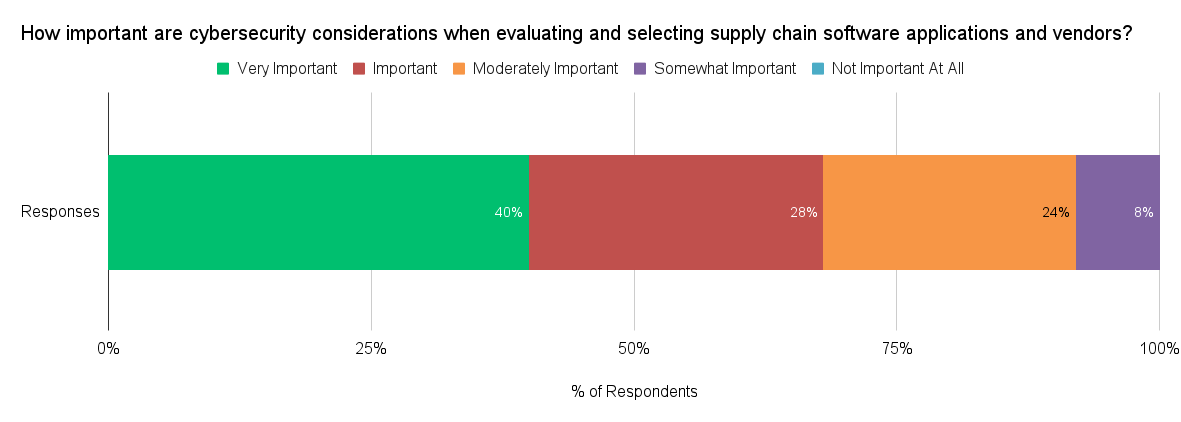
We also asked our members, “How important are cybersecurity considerations when evaluating and selecting supply chain software applications and vendors?” More than two thirds of the respondents (68%) said cybersecurity considerations are either “Very Important” (40%) or “Important” (28%) when evaluating/selecting supply chain software and vendors.
“We’ve been fortunate to not have experienced downtime related to a hack of a software vendor, but it really is only a matter of time until this occurs,” said one Indago supply chain executive. “It’s important to have mitigation strategies — including pen/paper and phone calls — to keep the business running, but it would be a massive step backwards from the way we run our day-to-day operations. I shudder at the thought of a [system going down for days] but that would likely be the case when this type of incident occurs.”
So, as we begin 2026, it’s worth asking these questions again: How prepared is your company for a cyberattack on its supply chain? Can you keep operations running if a cyberattack takes down your ERP, WMS, TMS, or other critical enterprise systems for hours or days? And how well are you working with external partners — suppliers, customers, carriers, logistics providers, and software vendors — to address vulnerabilities across the network?
Odds are that your supply chain will be impacted by a cyberattack in the future — perhaps sooner than you think. Ignore this risk at your own risk.