

What am I going to write about today?
That was one of the first decisions I had to make today. I’ll make another 35,000 or so decisions before the day is over. So will you — and many of those decisions will be almost automatic, like whether to turn left or right when you enter a store.
A much smaller subset of decisions, however, are more critical — requiring time to think through, data and information to evaluate the options, and input, advice, and buy-in from others.
That is certainly the case in the daily worklife of supply chain and logistics executives. The questions they face, and the decisions they have to make, are often complicated. Here are a few questions many of them are likely wrestling with today:
- How should we rebalance our sourcing and transportation networks in response to rising tariffs, geopolitical tensions, and the risk of sudden trade policy shifts — without permanently locking in higher costs?
- When do we absorb tariff-driven cost increases, and when do we pass them on to customers? How do we make those decisions without damaging long-term relationships?
- How much inventory risk are we willing to carry in an era of demand volatility? Where should we hold that inventory to best balance working capital, service, and exposure to disruption?
- Which technology investments should we prioritize now — upgrading core systems like TMS and planning tools versus experimenting with AI-driven decision support?
- How much decision-making should we automate, and where must human judgment remain firmly in control, especially when data is incomplete or conditions are changing rapidly?
- Do we design our supply chain for efficiency or optionality? Where should we place capital bets when the “right” network design keeps changing?
These types of decisions typically involve tradeoffs across cost, service, risk, resilience, flexibility, and sustainability (among other things). In some cases, you’re stuck — for better or worse — with the decision you make for many years.
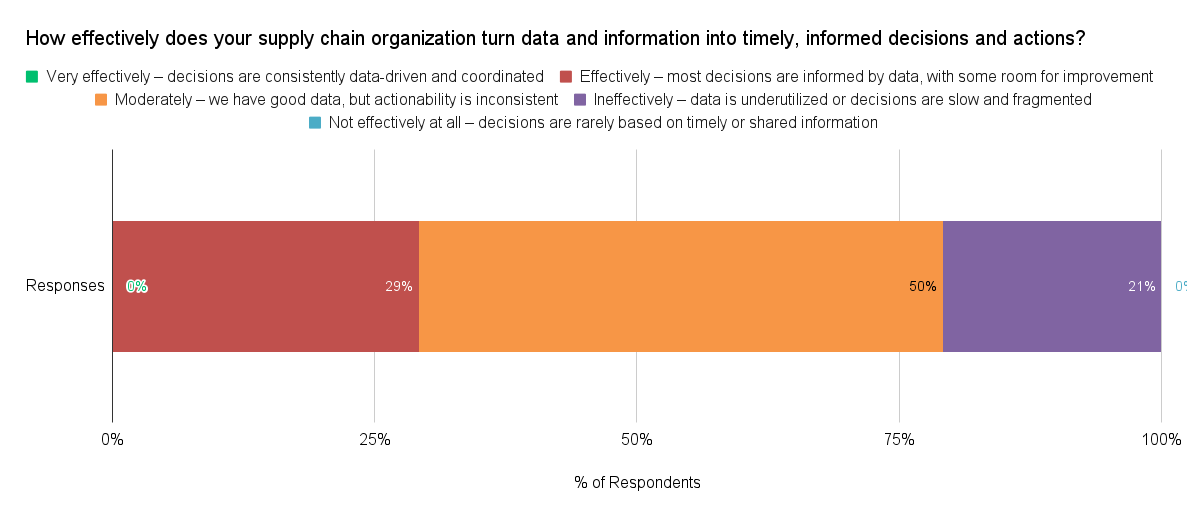
In May 2025, we asked members of our Indago supply chain research community — all supply chain and logistics executives from manufacturing, retail, and distribution companies — “How effectively does your supply chain organization turn data and information into timely, informed decisions and actions?”
Only 29% of respondents said they “Effectively” turn data and information into timely, informed decisions and actions; 50% said they are “Moderately” effective, and 21% said they do it “Ineffectively.” None said “Very effectively.”
Topping the list of barriers to cross-functional decision-making were “Data is available, but not trusted or easily interpreted,” “Siloed incentives across departments,” and “Communication breakdowns between functions.”
We’re revisiting this topic in this week’s Indago survey, but from a slightly different angle: how supply chain leaders are navigating this new reality of constant uncertainty, with a specific focus on how decisions are made, what has changed, and where leaders see the greatest challenges ahead.
In an environment defined less by stability and more by continuous disruption, the challenge isn’t simply making more decisions — it’s making better ones, faster, and with confidence. Understanding how supply chain leaders are adapting their decision-making processes, where they’re struggling, and what’s changed most in recent years is the focus of this week’s Indago survey.
If you’re navigating these same tradeoffs and uncertainties, we invite you to share your perspective and see how your experience compares with your peers. Join Indago today to take the short survey and receive the results.
Now, do I risk going to the gym with my broken ankle in a boot — or stay home for a sixth consecutive day?