
I spent much of yesterday shoveling out from the blizzard that swept through Boston, dumping more than 20 inches of snow. This morning, I’ve been shoveling through a blizzard of newsletters and blog posts about last Friday’s Supreme Court ruling that effectively ended the Trump tariffs under the International Emergency Economic Powers Act (IEEPA).
The Trump administration almost immediately responded by imposing a 15% tariff on all imports under Section 122, effective for 150 days. For now, the rate is 10%, with an increase to 15% expected once the president signs the executive order.
The soap opera continues.
The big news this morning is that FedEx filed a lawsuit yesterday in the U.S. Court of International Trade seeking a refund for the IEEPA tariffs. As reported by Reuters, “a flood of lawsuits to recover billions of dollars is expected by trade attorneys after the blockbuster [Supreme Court] ruling. The recovery process still has to be worked out by a lower court, though, complicating the matter.”
The article adds that the law firm representing FedEx — Washington, D.C.-based Crowell & Moring — “also represents discount club retailer Costco, cosmetics firm Revlon, eyewear seller EssilorLuxottica and other companies in IEEPA tariff refund cases.”
One thing is clear: pursuing refunds will be long, complex, and documentation-intensive — and many companies are simply not ready.
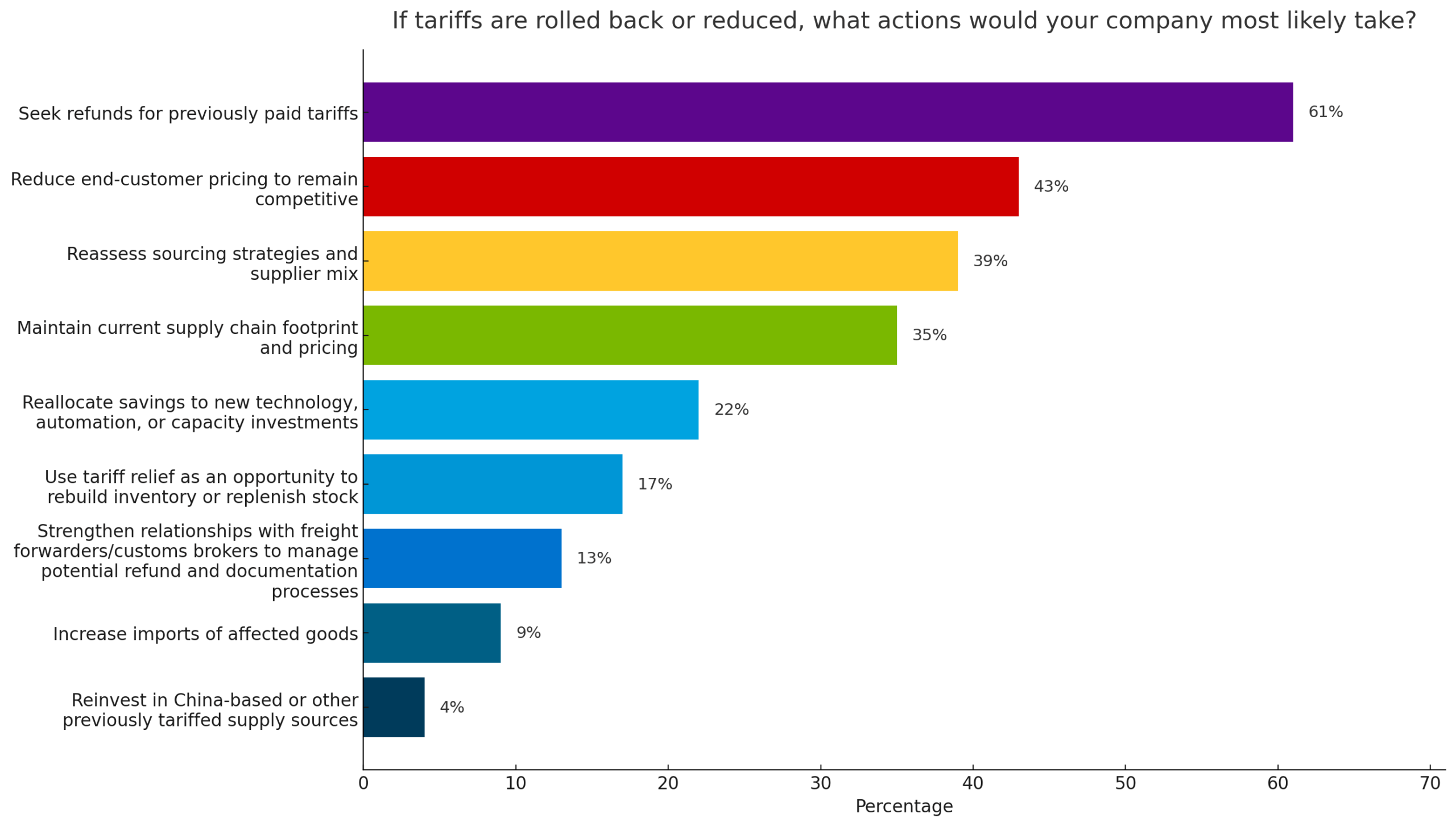
Last November, we asked members of our Indago supply chain research community — supply chain and logistics executives from manufacturing, retail, and distribution companies — what actions they would take if the Supreme Court invalidated the Trump tariffs under IEEPA. 61% said they would seek refunds.
We also asked our members, “How prepared is your company to pursue potential tariffs refunds?”
Within our response group, most companies felt at least somewhat ready to file for tariff refunds, but only a minority were fully prepared.
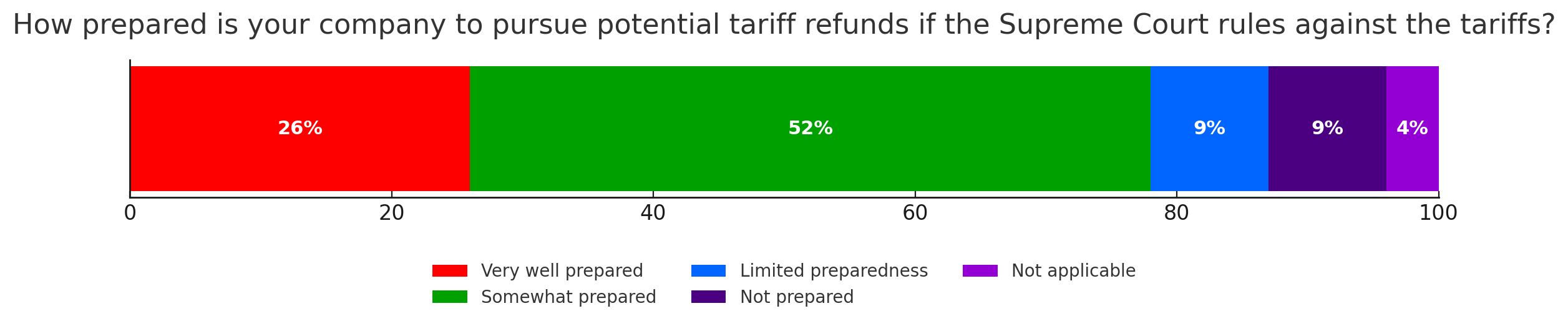
However, a notable 22% of respondents said they lacked readiness, either due to weak documentation processes or reliance on external help. These firms may struggle to capture refunds efficiently or at all, especially if timelines are tight or documentation requirements stringent. This divide highlights a broader risk: companies that haven’t invested in global trade management capabilities may leave significant money on the table — not just this time, but the next time policy shifts again.
The sun is out today and the sky is blue — but more snow is expected tomorrow (“just” 2-3 inches).
It’s the same with the global trade environment. The blizzard that was the IEEPA-based tariffs is behind us, but more change and uncertainty is expected in the weeks and months ahead.
If the events of the past year didn’t prompt you to elevate your global trade management capabilities — whether internally or through the right partners — it’s not too late to start. Because if the past year has proven anything, it’s this: tariff policy can change faster than most companies can react.
So what does “elevating your capabilities” actually mean? At a minimum, it means taking a hard look at the following:
- Assess your readiness. Do you have the documentation, historical data, and internal processes needed to quantify exposure and pursue refunds quickly?
- Strengthen your data and documentation discipline. Ensure import records, HTS classifications, broker filings, and duty payments are accurate, accessible, and audit-ready.
- Clarify ownership. Define what your internal team owns versus what your customs broker or external advisors handle (and make sure you have visibility either way).
- Invest in the right technology. Modern global trade management solutions can automate compliance, model tariff exposure, and support drawback and refund workflows.
- Run scenario planning exercises. Don’t wait for the next policy shift. Model the financial and operational impact of tariff increases, removals, or country-specific actions now.
- Elevate trade to the executive agenda. Tariffs affect margin, sourcing, inventory, and network design. Trade management shouldn’t sit in the background.
You can’t control policy shifts, but you can control your readiness.