

Editor’s Note: The following is an excerpt of a research report published recently, “How Ready Is Your Supply Chain for ESG Regulations?” The research, conducted by Adelante SCM and commissioned by Infor, explored the current state of ESG compliance — how companies are prioritizing ESG compliance, the progress they’ve made, and the obstacles they still face. Please download the full report for all the research results.
As new Environmental, Social, and Governance (ESG) regulations such as Corporate Sustainability Reporting Directive (CSRD), Uyghur Forced Labor Prevention Act (UFLPA), and European Union Deforestation Regulation (EUDR) gain momentum globally, supply chain leaders are facing rising pressure to achieve end-to-end transparency and compliance across all supplier tiers.
We conducted a survey with members of the Indago supply chain research community, who are all supply chain and logistics executives from manufacturing, retail, and distribution companies, to understand how companies are prioritizing ESG compliance, the progress they’ve made, and the obstacles they still face.
ESG Compliance Still Not a High Priority
Despite the growing global focus on ESG compliance, most companies appear to be in the early stages of their journey. More than half of the respondents (52%) said ESG compliance is either a low priority (33%) or not a current priority (19%) within their organizations. Only 4% described it as a very high priority today.
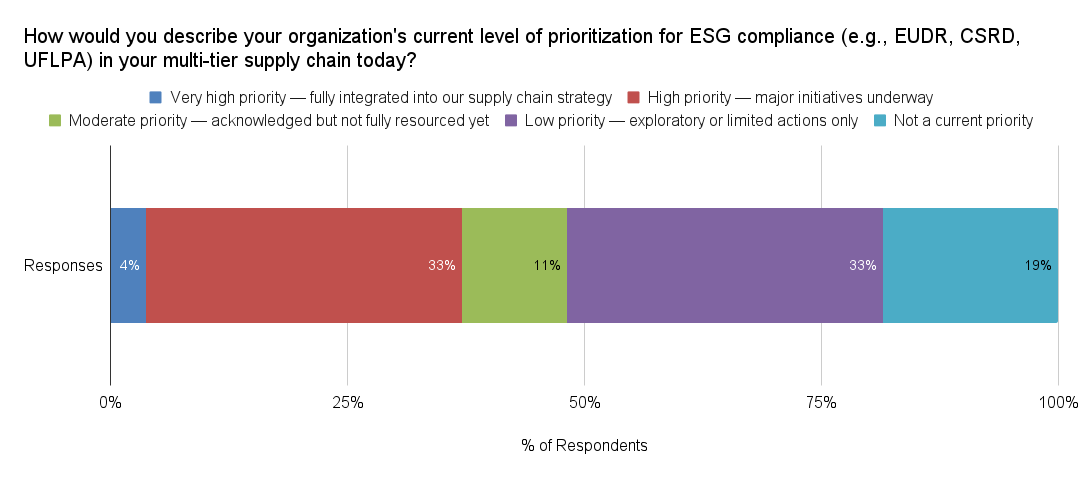
This sentiment is reflected in one executive’s comment:
“This is not a current priority for our organization due to staffing, costs, ROI/payback, requirements, and needs. As our customers demand more information, we will eventually be forced into further action in this area.”
In other words, for many companies, ESG compliance remains more of a reactive necessity than a proactive strategy — something they’ll invest in once customer or regulatory pressure intensifies.
Limited Visibility Beyond Tier 1 Suppliers
When asked about their visibility into ESG-related risks and data, 44% of respondents said their visibility extends only to Tier 1 trading partners, while another 30% reported having no structured visibility at all. Few companies are able to see deeper into their supply chains, where the greatest risks often reside.
As one respondent explained:
“Some of the biggest challenges for us are the costs for securing the data needed to understand the true picture of our ESG compliance beyond Tier 1 — and the unwillingness of our suppliers to share that data. We are an SMB with limited leverage to acquire that data from our suppliers.”
This underscores one of the most persistent obstacles in achieving ESG transparency — the lack of collaboration and data sharing across multi-tier networks.
For additional insights from the research — including which approaches companies are currently taking to collect and manage ESG-related data from their supply chain partners, and what their timeline is for achieving multi-tier ESG visibility and data transparency — please download the full report.