

Look what’s back in the headlines: diesel prices!
“Diesel prices for U.S. truckers rose a record 96 cents a gallon this past week, an ominous sign for retailers and manufacturers juggling tariffs and bracing for higher shipping costs following the U.S.-Israeli attacks on Iran,” reported Paul Berger in the Wall Street Journal yesterday.
According to the article:
The average on-highway price for diesel increased 25% for the week ended March 9 to $4.859, according to the U.S. Energy Information Administration. Avery Vise, a trucking analyst at FTR Transportation Intelligence, said the rise was the largest ever weekly increase in both price a gallon and percentage terms since the government started tracking diesel prices in 1994.
Let’s roll the film back four years, when on-highway diesel fuel prices were $5.134 per gallon on March 22, 2022 — up $1.940 from the previous year.
At the time, since fuel costs ultimately get passed on to shippers via fuel surcharges, we asked members of our Indago supply chain research community — supply chain and logistics executives from manufacturing, retail, and distribution companies — the following question:
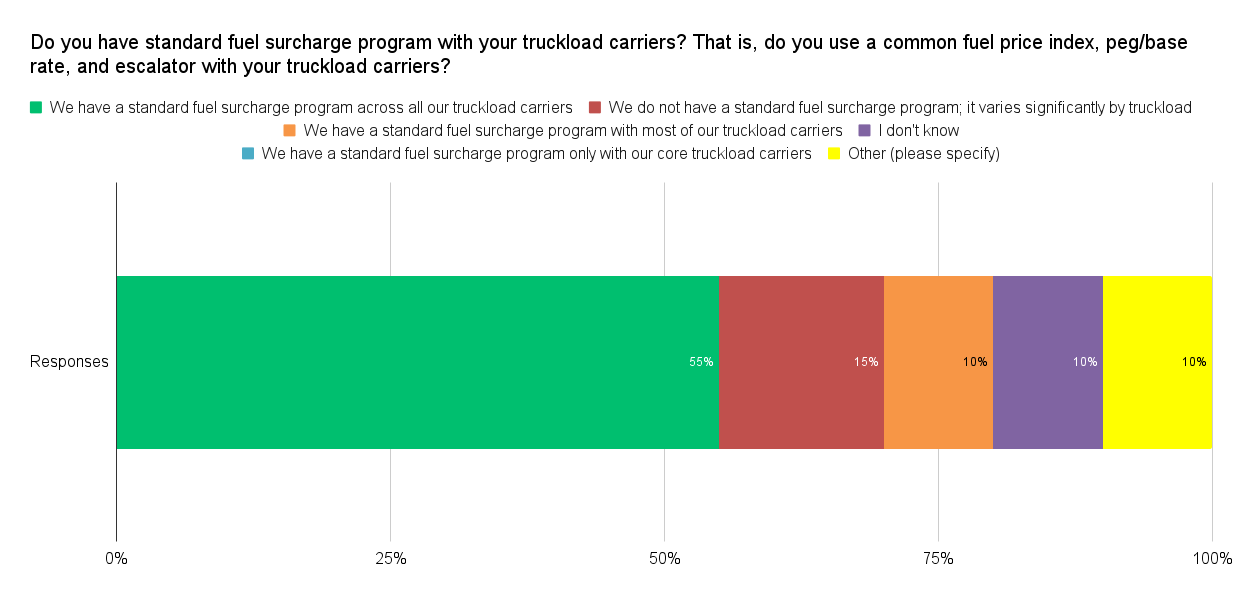
“Do you have a standard fuel surcharge program with your truckload carriers — that is, one that uses a common fuel price index, base rate, and escalator?”
Among our small group of respondents, a majority (55%) reported having a standardized fuel surcharge program across all truckload carriers, with another 10% applying a standard program across most carriers. However, 15% said their programs varied significantly by carrier, and another 20% either didn’t know or selected “other,” highlighting that fuel surcharge management is not always fully standardized or visible across organizations.
Here’s how some of the respondents characterized their approach to fuel surcharges at the time:
“We ‘set it and forget it’ — we should see what others are doing.”
“Current tools to adjust to changing freight charges are manual and do not react quickly enough to protect margins. We are looking to make the tool more dynamic and reactive.”
“Our 3PL manages this with the underlying carriers and does a poor job of giving us visibility.”
“Fuel surcharges [FSC] are 100% profit makers for carriers. For truckload carriers, despite the matrix I ask them to use, it’s a bottom-line price they look for and if we don’t ‘give in’ we don’t get equipment… FSC were meant to compensate carriers for their added costs of fuel. Years ago, and well into today, it’s a profit center for them.”
“High diesel rates (and, therefore, higher surcharges) are an added incentive to evaluate alternative fuel and power options in order to reduce exposure to the high cost of diesel while also meeting sustainability objectives.”
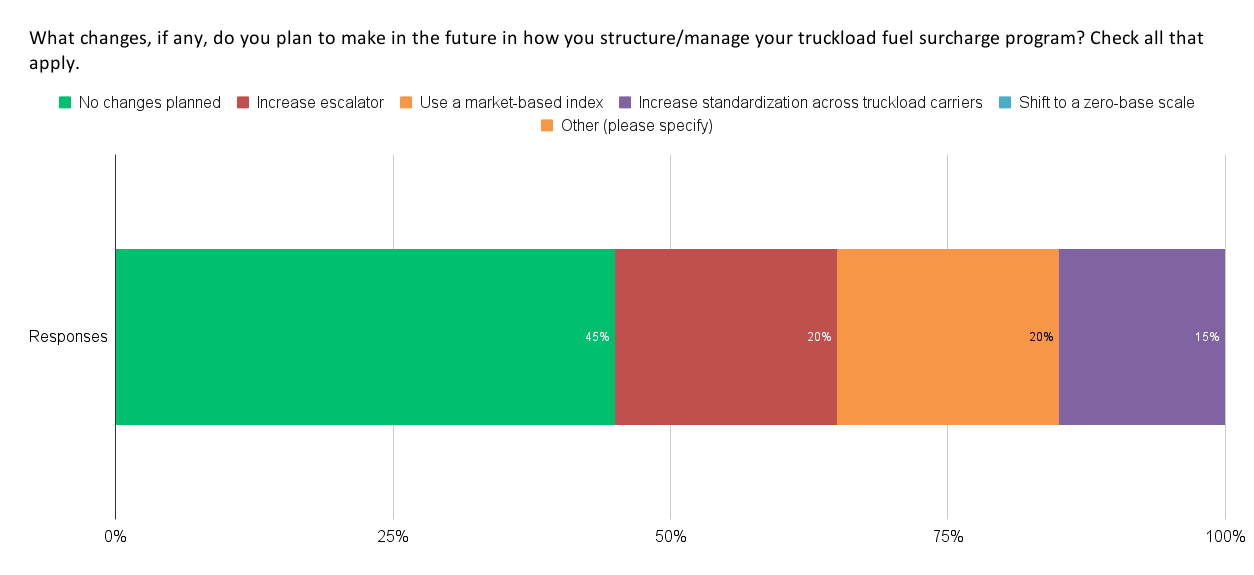
Looking ahead, nearly half of respondents (45%) said they didn’t plan to make any changes to their fuel surcharge programs. That said, others reported considering adjustments, including increasing the escalator (20%), adopting a more market-based fuel index (20%), or increasing standardization across carriers (15%). These planned changes likely reflected the pressure that rising and volatile diesel prices can place on transportation budgets.
If the survey results still hold true, then many shippers may benefit from revisiting how their fuel surcharge programs are structured, standardized, and governed, particularly in this current wave of fuel price volatility. If your fuel surcharge program was “set and forgotten” a while ago, your transportation budget may be in for a rude awakening.