

I am taking the afternoon off to tighten screws.
Literally.
There are loose screws everywhere in this house.
All the screws on our door knobs, loose
from all the opening and closing.
All the screws beneath our dining room chairs, loose
from all shifting in our seats.
The screws behind our kitchen cabinet knobs? The screws
inside the plastic feet of our rice cooker? They’re loose too.
Even the tiny ones on my reading glasses need to be tightened.
I know what you’re thinking: Adrian has a screw loose.
But that one was stripped long ago, and I can’t reach it.
Some loose screws, I’m afraid, you just have to live with.
—
Moving on, here’s the supply chain and logistics news that caught my attention this week:
- America’s Four-Year Trucking Slump Is Finally Over (WSJ – sub. req’d)
- Appeals court says U.S. government can keep collecting 10% tariffs for now (ABC News)
- Amazon Freight LTL is now available to shippers of any size to any type of destination
- Trump says he may not renew USMCA with Mexico and Canada (The Hill)
- Driverless Trucks Are Here—and They’re Delivering Bags of Doritos (WSJ – sub. req’d)
- Einride, a Global Leader in Autonomous and Electric Freight, Completes Business Combination and Will Begin Trading on Nasdaq Stock Market
- Volvo Autonomous Solutions plans fully driverless operations in Q1 2027 (TruckingDive)
- Wing and Walmart name seven new markets for drone delivery service
- Neura Robotics Announces Record Series C Of Up To $1.4 Billion To Accelerate The World’s Leading Physical Ai Platform
- Trimble Unveils Next-Gen Shipper TMS to Redefine Supply Chain Flexibility
- Alpega Group And Wakeo Formalise Strategic Alliance To Deliver Unified Transport Intelligence To Shippers Worldwide
- Nearly 11,000 Bourbon Bottles Worth ‘Half a Million’ Dollars Stolen from Philadelphia Warehouse in ‘Broad Daylight’ (People)
- D.A. Bragg, NYPD & BIC: Eight Indicted For Impersonating Shipping Carriers In Multi-State Retail Theft Ring
- Ohio Revokes CDLs for 1,200 Foreign Truckers (Transport Topics)
- Citing fallout from Iran war, World Bank cuts forecast for global economic growth (AP)
Would You Put Your Freight on a Driverless Truck Today?
Will there be a future for driverless trucks in logistics? Will that future arrive soon or many years from now, if ever?
That was the opening question of a post I wrote almost a decade ago titled, “Driverless Trucks: Heading Somewhere or Nowhere Quickly?”
It hasn’t happened quickly. But it increasingly appears that driverless trucks are heading somewhere — and perhaps sooner than many expected.
In The Wall Street Journal this week, Esther Fung reports that PepsiCo is operating 35 driverless trucks in Arizona, “marking it as the first major U.S. consumer-goods company to disclose the real-life, large-scale use of autonomous trucks on public roads. They are traversing busy highways and local streets as they transport PepsiCo products between bottling plants, storage facilities and stores like Walmart and Dollar General.”
“These operations that we’re running today are real,” said Jim Farrell, PepsiCo’s senior vice president of supply chain. “They are running in multiple markets in a live network, not like some experimental test environment.”
Also this week, as reported by Larry Avila in Trucking Dive, “Volvo Autonomous Solutions said it will remove the safety driver and go fully driverless on U.S. highways in Q1 2027, the company announced at its capital markets day event in Sweden Wednesday.”
Here are some excerpts from the article:
“We’re good to go next year,” Nils Jaeger, president of Volvo Autonomous Solutions said at the event, adding that by the end of 2027, the company will be operating more than 300 autonomous trucks on U.S. highways, followed by industrial scaling in 2028. The trucks mentioned by Jaeger will primarily be operating across the U.S. Sunbelt, according to an event presentation.
The driverless shift brings its testing portion to a close and moves the company towards scaling the tech. In 2024, the company debuted tractors with Aurora Innovation’s driverless technology and fully integrated production of the tech at its New River Valley facility in Dublin, Virginia…In May, the companies launched a new 200-mile driverless route between Dallas and Oklahoma City.
And in other related news, Einride — “a technology company driving the transition to cost-efficient autonomous and electric freight” — began trading on Nasdaq under the ticker symbols “ENRD” and “ENRDW.”
As I wrote back in January 2025, it’s been a “Long, Bumpy Road To Deploying Driverless Trucks At Scale” — but progress continues to be made.
The technology may finally be moving from pilot projects to commercial operations. But are shippers ready?
Back in August 2022, we asked members of our Indago supply chain research community — supply chain and logistics executives from manufacturing, retail, and distribution companies — “What are the biggest reasons why your company is not testing driverless trucks at this time?” Topping the list at the time was “Our carriers/brokers are not offering driverless trucks at this time,” with 75% of the respondents selecting it. “Technology is not mature enough yet to test” (38%) and “Cost or service benefits not evident at this time” (29%) rounded out the top three.
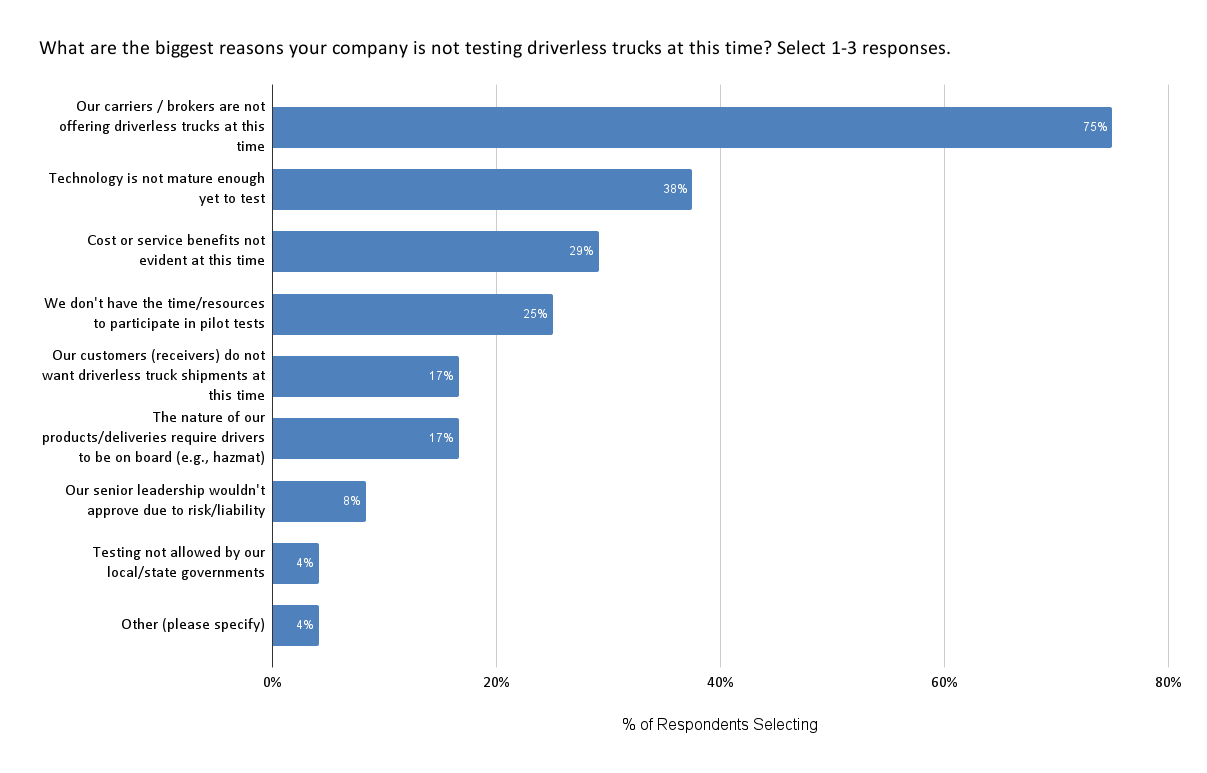
Assuming the survey results still hold today, the next major milestone won’t simply be more autonomous trucks on the road. It will be when large carriers such as JB Hunt, Werner Enterprises, Knight-Swift, Schneider National, and others begin routinely offering true driverless capacity to shippers — that is, routes operated without a safety driver on board and available through normal procurement and transportation management processes.
In other words, the question may soon shift from “Can autonomous trucks operate safely?” to “Will shippers buy the capacity?”
When do you think that will happen? Would you book that capacity today or do you still have concerns (liability or otherwise) about having a driverless truck haul your freight?
And one more question: now that the freight recession is apparently over, with capacity tightening and rates rising, would that influence your decision to use driverless trucks sooner rather than later?
Post a comment and share your perspective!
And with that, I have to gather my screwdrivers. Have a meaningful weekend!
Song of the Week: “Always the Sun” by The Stranglers