

Last June in The Wall Street Journal, Esther Fung reported how “new advances in robotics are [enabling the automation of truck loading and unloading]. Improved sensors and algorithms, advancements in AI and faster image-processing technology are making these robots proficient players in tasks that are like a game of 3-D Tetris.”
The article prompted us to survey members of our Indago supply chain research community — supply chain and logistics executives from manufacturing, retail, and distribution companies — about the use of robots for loading and unloading trailers and containers.
At the time, only 4% of respondents reported deploying robots at a single site or pilot scale, while none reported deployments across multiple facilities. In contrast, 96% have not yet implemented the technology, including 57% who are interested in the future and 39% who currently have no plans.
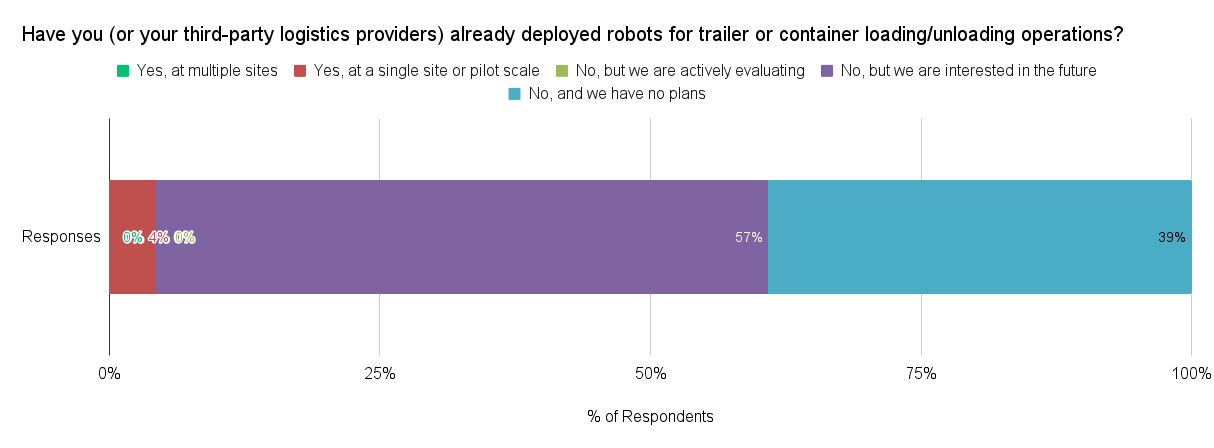
The findings suggest that interest in the concept exceeds confidence in the current economics and operational fit. As one respondent noted, “We would be interested in potentially exploring this opportunity in the future, when we are more comfortable with the technology and the economics.” Another executive highlighted a practical challenge: “Their solutions just do not work with how we load trucks and would cost us cube utilization in a truck. The loss of cube in the truck would not be offset by the enhanced productivity.”
In short, while robotic loading and unloading has captured attention, most organizations (at least within our research community) remain in an observation and evaluation phase rather than an implementation phase.
When we asked our members why they would consider robotic loading and unloading, the answers centered on economics and labor. Cost reduction was the leading motivation (78%), followed by labor shortages and difficulty finding workers (65%). Safety and ergonomics improvements (48%) and increased throughput and speed (48%) also ranked highly.
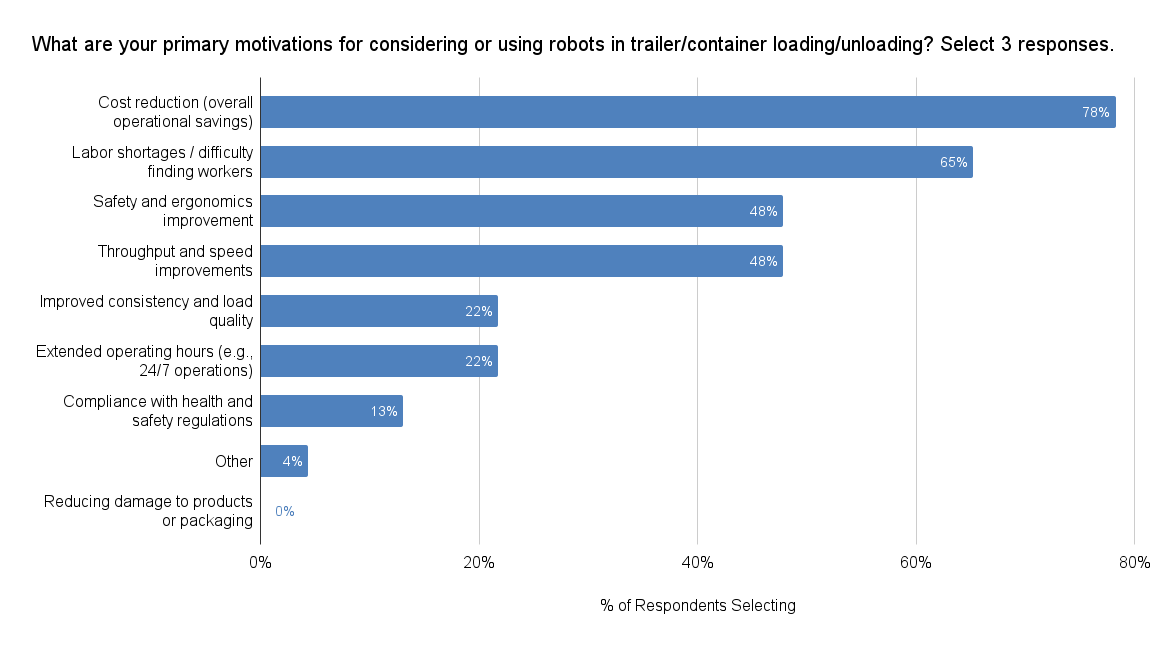
These results reflect the persistent challenges associated with loading and unloading operations, which are often physically demanding, labor-intensive, and difficult to staff. As one respondent noted, “Receiving and shipping capacity due to labor issues and/or the speed at which loads can be received and shipped has always been a problem and it needs much attention.”
Several executives also highlighted the operational resilience robots could provide. One respondent said robots could deliver “increased trailer utilizations and increased throughput despite heat, health, or labor related issues.” Another emphasized that automation should be viewed as part of a broader warehouse strategy rather than a standalone initiative, noting that loading and unloading technologies need to work seamlessly with put-away, picking, and transportation processes to avoid simply shifting bottlenecks elsewhere.
Simply put, the results suggest that companies view robotic loading and unloading as a potential solution to longstanding labor, productivity, and safety challenges.
In terms of barriers to adoption, cost tops the list. 83% of respondents cited high upfront investment costs, making it by far the most significant obstacle. The second-largest concern was the complexity of handling varied load types (57%), followed by uncertainty about return on investment (39%) and concerns about technology maturity and vendor options (30%).
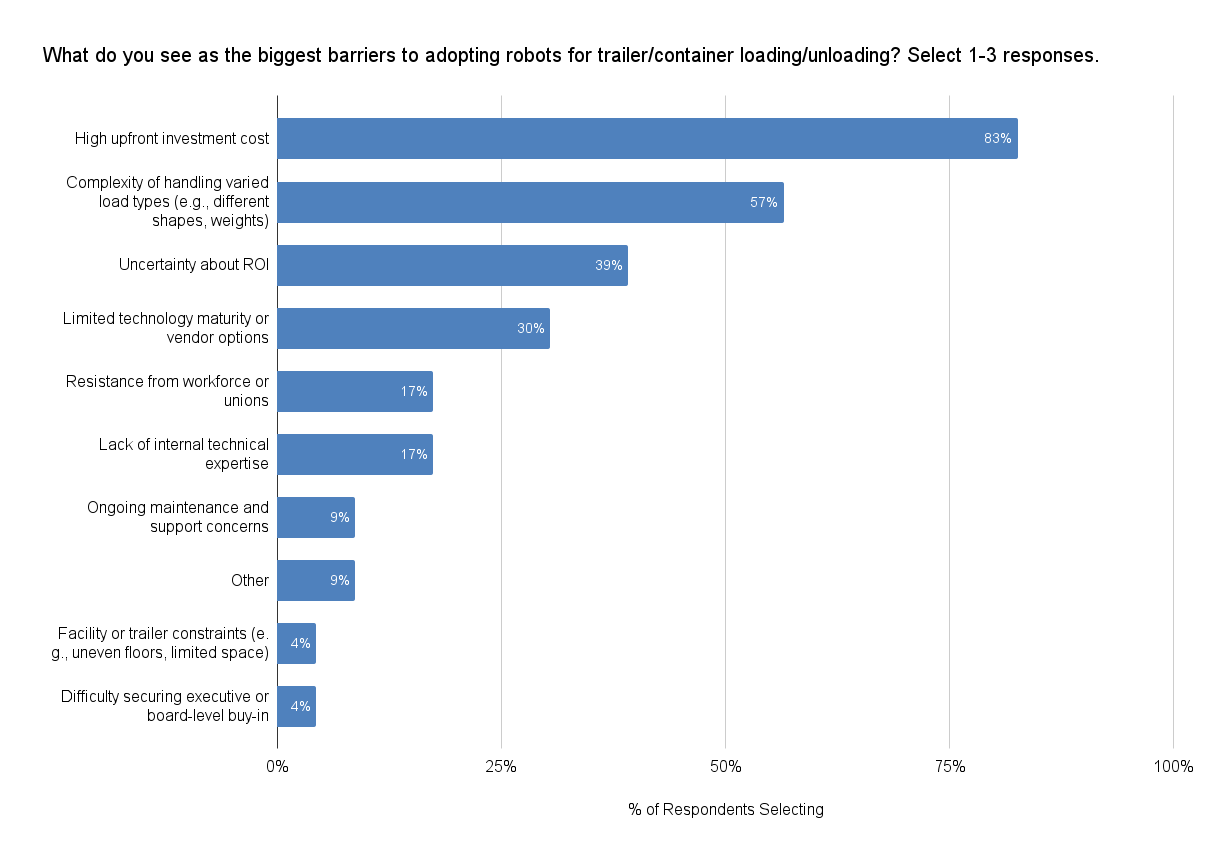
Interestingly, workforce-related concerns ranked much lower. Only 17% cited labor or union resistance, and just 4% pointed to difficulty securing executive support. This suggests that the challenge is less about organizational willingness and more about proving that the technology can reliably handle the realities of loading and unloading operations.
The qualitative feedback reinforces this point. One executive remarked that “ROI / efficiency is tough in the beverage industry,” while another noted that robotics solutions often struggle with real-world variability. As another respondent summarized, “Like most new technology, the first use cases will be for handling the easiest operational situations.”
In short, respondents are not questioning the potential value of automation. They are questioning whether today’s solutions can consistently deliver that value across the diverse load configurations, operating environments, and workflow requirements common in distribution and transportation operations.
That said, despite the limited adoption reported today, respondents generally believed the technology would become mainstream over time. Sixty-one percent expected widespread adoption within five years, while another 26% believed it would take six to ten years.
The results suggest cautious optimism. Most executives see robotic loading and unloading becoming more common, but only after vendors demonstrate stronger economics, greater flexibility in handling varied load types, and clearer returns on investment.
It’s been a year since we conducted this survey. Has the adoption needle moved? Have the economics improved? Are you using robots to load or unload trailers and containers today, and if so, what has your experience been? Post a comment and share your perspective.