

Are you still skeptical about the business value of digital twins?
This past January, I highlighted how PepsiCo had entered into a multi-year collaboration with Siemens and NVIDIA to transform plant and supply chain operations through advanced digital twin technology and AI (see “PepsiCo Demonstrates How Digital Twins Deliver Quantifiable Benefits” for more details.)
This news prompted us to survey our Indago members — supply chain and logistics executives from manufacturing, retail, and distribution companies — about the strategic importance, readiness, and potential value of AI-enabled digital twins within their organizations.
Among respondents, adoption of digital twins for facility planning and operational simulation remains very early-stage. No organization indicated that digital twins are a core part of how they plan facilities or design layouts today. Instead, 40% are not considering digital twins at all, 20% are uncertain about their organization’s plans, and 15% continue to rely primarily on traditional, physical-first methods. Only a small minority are experimenting, with 10% actively expanding beyond pilots and 15% exploring limited or experimental use cases.
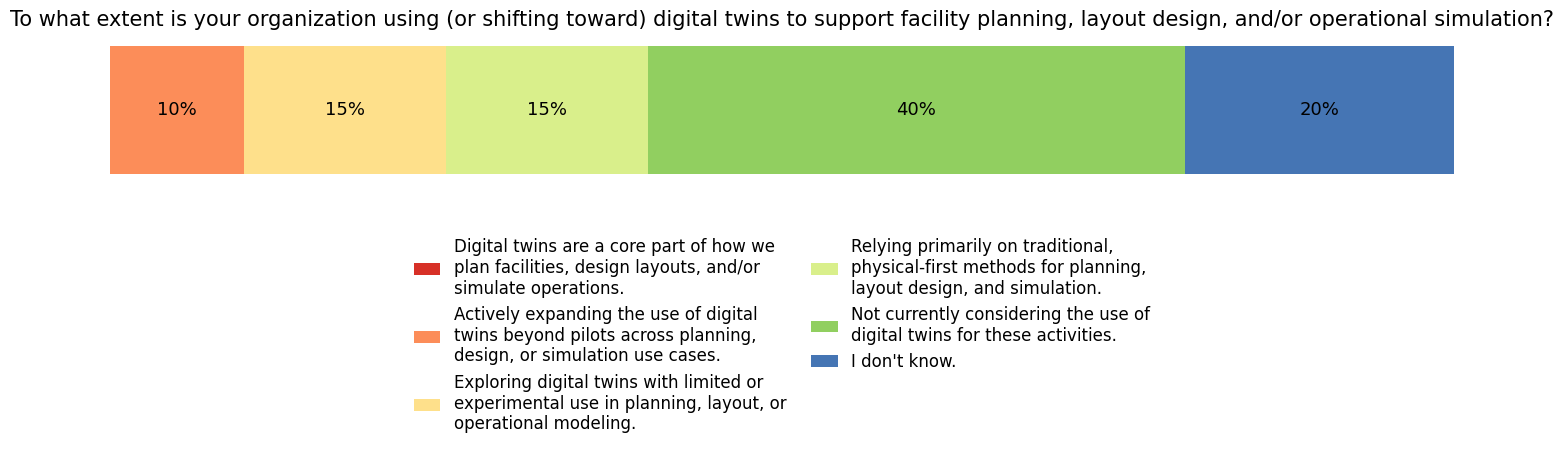
The comments suggest that limited adoption is driven less by lack of interest and more by resource constraints, cost concerns, and competing priorities. One respondent noted, “We don’t spend enough time evaluating these kinds of tools due to lack of resources,” adding that their focus is on network optimization rather than facility-level simulation. Others highlighted that digital twins are still perceived as more viable for large, complex networks, with one respondent stating, “I think digital twins make more sense the larger the organization in terms of physical locations and network flow points.”
This point was echoed by another member: “I’m interested to see if AI tools can be leveraged to help build out digital twin solutions for SMBs. While it’s great that Pepsi could roll this out, they have significantly more resources than most businesses — and pretty much any business could benefit from building out a digital twin of their operations.” This underscores both the perceived value of digital twins and the need to make these capabilities more accessible and affordable for small and midsized businesses.
We also asked our Indago members where AI-enabled digital twins could deliver the most value. Respondents focused less on cost reduction and more on improving decision-making. The top-ranked use case was identifying hidden constraints and bottlenecks before making physical changes (60%), followed by enhancing end-to-end operational visibility (50%) and supporting scenario planning and resilience to disruptions (45%). Improving throughput and capacity utilization (35%) and accelerating facility design timelines (30%) also ranked highly.
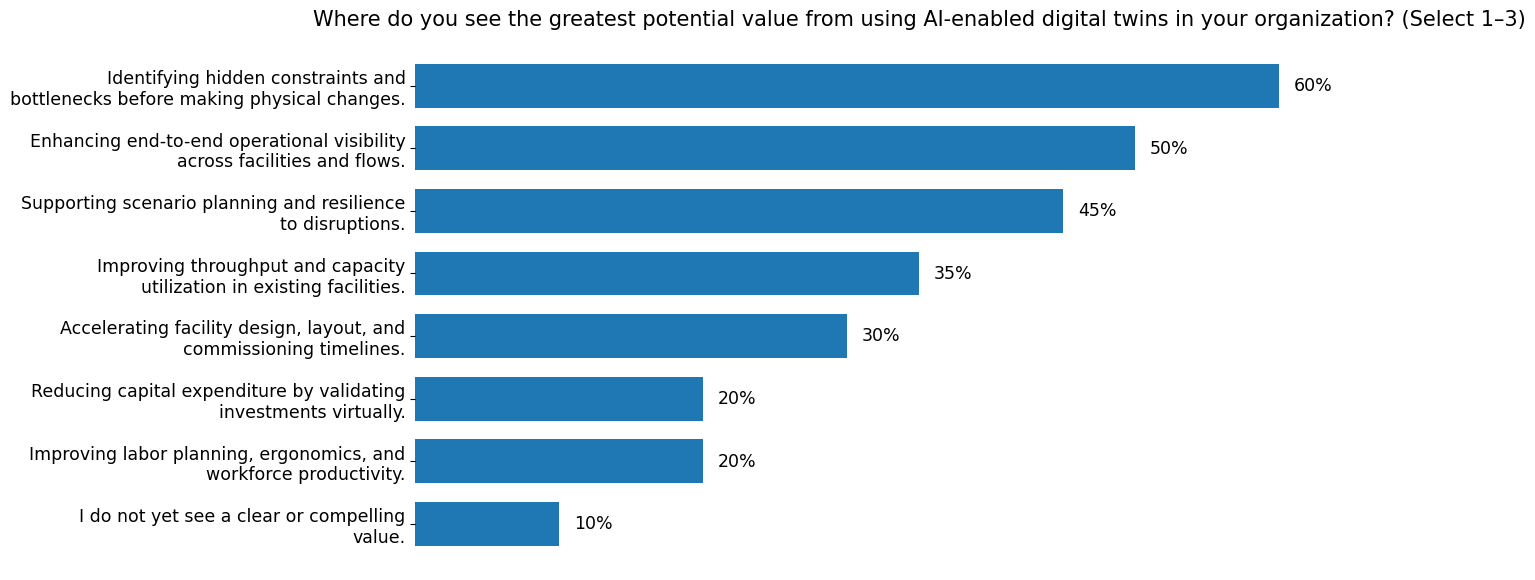
The comments align closely with these priorities. One respondent emphasized the importance of uncovering non-obvious opportunities: “I would like to see the real strength of this tool in helping us to identify opportunities that are not currently obvious to us.” Another pointed to the potential of AI-driven scenario modeling as a breakthrough capability: “Having the ability to model logistics costs with AI would be a game changer: what will happen if tariffs on certain products increase or decrease? How does lead time change?” Still, a small but notable group (10%) does not yet see a clear or compelling value, underscoring that the use cases are not universally understood or proven.
If you need another real-world example of digital twins and AI creating measurable business value, consider how Walmart is using these technologies “to anticipate [weather-related] disruptions, model potential outcomes, and make informed decisions about inventory, transportation and fulfillment.”
Here are some excerpts from a blog post the company published in June 2026 (“Moving Before the Storm: How Walmart’s Supply Chain Technology Helps Teams Prepare for Severe Weather”):
Our engineers have proactively built a connected ecosystem where real-time weather intelligence seamlessly integrates with our core operational infrastructure. By pairing machine learning with advanced simulation tools, our systems analyze fluid weather forecasts alongside logistics data to generate proactive, data-driven decisions that help associates protect our supply chain and support local communities.
As weather forecasts emerge, teams begin asking a series of “what if” questions.
- What happens if demand for bottled water, batteries, or other essentials spikes ahead of a hurricane?
- What happens if a fulfillment center loses capacity?
- What happens if inventory needs to move closer to customers in a specific region?
To answer these, Walmart utilizes predictive AI and machine learning models that analyze historical weather patterns and real-time data feeds. Instead of reacting after a disruption occurs, planners use these simulations to gain immediate visibility into how weather could affect inventory availability, transportation routes, and customer deliveries.
A key part of this process is digital twin technology.
Transportation teams use these virtual replicas of our logistics network to simulate how goods move across the supply chain under stress. By visualizing the network digitally, the AI helps teams evaluate capacity needs, align stores with alternative distribution centers, and make proactive adjustments that keep products flowing smoothly.
Together, these capabilities help teams move from reacting to disruption to planning for it.
It’s clear that companies with very large and complex supply chains, like PepsiCo and Walmart, are leading the way in deploying AI-enabled digital twins. Our research suggests that many other companies recognize the potential business value as well, even if they aren’t ready to invest today. Organizational readiness, ROI justification, system limitations, and resource constraints remain significant barriers.
The bigger question isn’t whether digital twins can deliver value — PepsiCo and Walmart have already demonstrated that they can. The question is how quickly advances in AI, cloud computing, and software platforms will make these capabilities practical and affordable for companies of every size. As that happens, digital twins may evolve from a competitive advantage for industry giants into a standard planning and decision-support tool across the supply chain.