

Editor’s Note: The following is an excerpt from the recently published research report, “The New Strategic Logistics Service Provider: What Winning Freight Forwarding and Customs Brokerage Leaders Are Doing Differently.” Conducted by Adelante SCM and commissioned by Magaya, the research examines how freight forwarders and customs brokers are responding to rising uncertainty, evolving customer expectations, and the growing role of technology and AI in daily operations. To access the complete findings, download the full report.
Are freight forwarders and customs brokers moving fast enough — and in the right direction?
That is the central question explored in the research, which combines survey responses from 125 freight forwarders and customs brokers with executive interviews conducted at the Magaya Momentum conference.
Together, the findings point to an industry at an inflection point where technology, customer expectations, workforce transformation, and strategic agility are converging to redefine what leadership will look like over the next three to five years.
Customers Want Strategic Partners, Not Service Providers
Execution alone is no longer enough.
Customers increasingly expect visibility, responsiveness, integration, proactive communication, and strategic guidance, not simply transactional freight movement.
Jorge Zachrisson, CEO and Founder of FlexCargo International, framed the shift clearly: “Customers today are not really looking for freight forwarders. They’re looking for companies that can help them make better decisions.”
He explained that his company focuses on understanding the entire customer process — from sourcing and inventory through final delivery — to identify friction points and opportunities for improvement.
Kelly Brown of FORE+AFT described a similar evolution toward deeper collaboration with customers. Discussing her relationship with a key client, Brown explained: “We’ve integrated a lot of our data. We share the same data, and many of the processes I’ve set up within my company have been specifically designed to help them improve their efficiencies and the way they manage their business.”
Marco Gutierrez, founder of Marco Polo Freight Forwarding, highlighted how smaller forwarders can differentiate through customer service and hands-on support. “We’re a small company, but with a huge heart. Sometimes customers don’t know exactly what they’re doing. It may be their first time exporting something into their country, so we help them with everything that’s necessary.”
Rosswell Rojas of Mybox summarized the growing customer mindset: “Customers don’t necessarily want to know how everything works — they just expect it to happen. They need a solid partner that can reliably deliver supply chain and logistics outcomes.”
Meanwhile, Alex Hoyos of Herco Freight Forwarders emphasized the growing demand for real-time information: “Customers want information right away. They want answers, tracking information, and updates on when cargo is going to arrive.”
The survey findings reinforce this shift. Only about one-quarter of respondents described their organizations as highly digitally integrated, yet respondents repeatedly cited integration and connectivity as critical future differentiators.
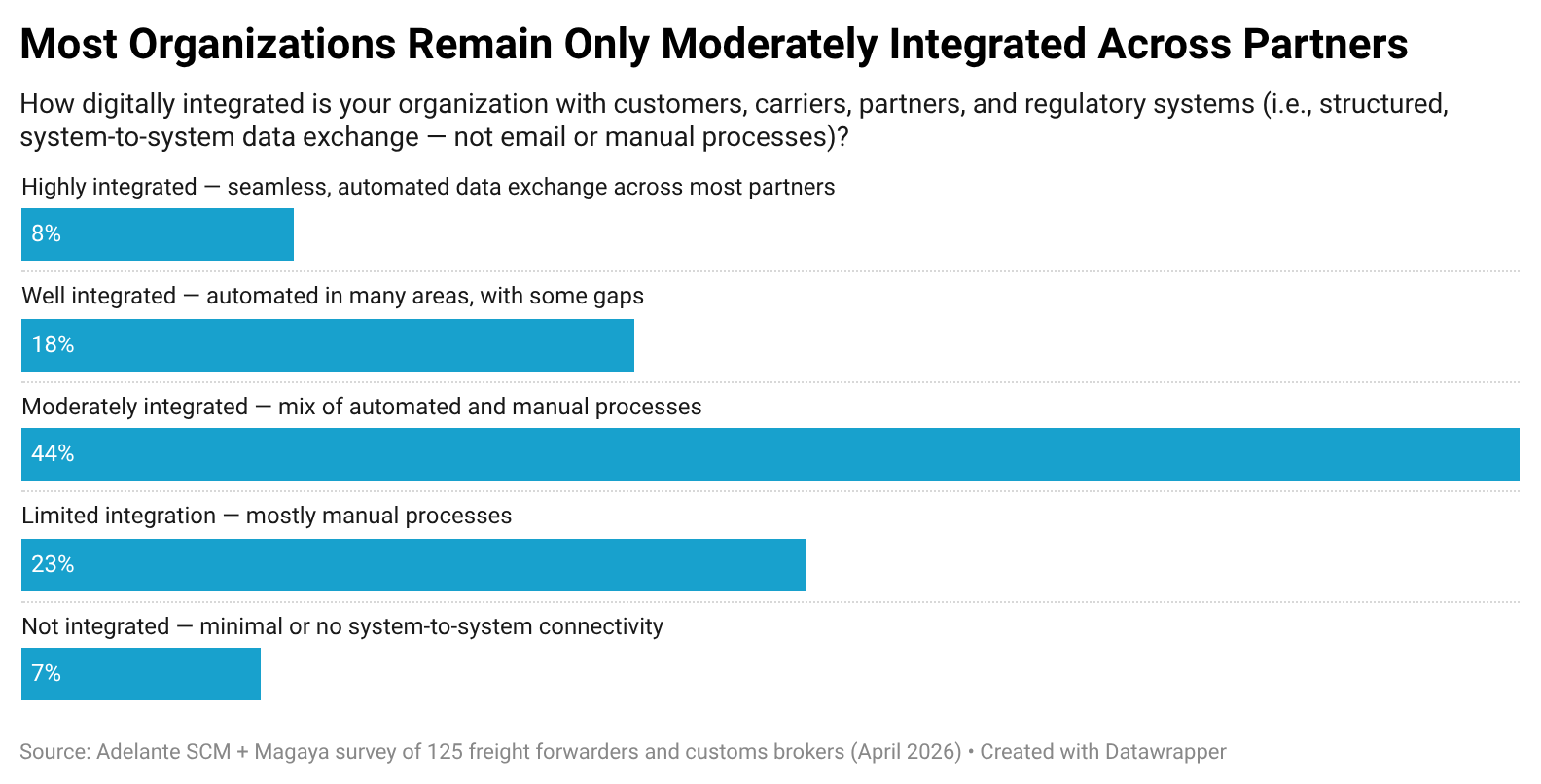
As one survey respondent stated: “The leaders will be defined by their ability to achieve true digital integration.”
For additional insights from the research, including what separates industry leaders from their competitors and the actions logistics service providers are taking to strengthen their competitive position, please download the full report.