

Last week, I put on my guayabera and flew down to Miami for the Magaya Momentum conference.

This year marks Magaya’s 25th anniversary — a notable milestone in the highly competitive and constantly evolving logistics software industry. Magaya Momentum was the company’s first-ever user conference bringing together customers, partners, and industry experts under one roof. More than 225 logistics professionals from the freight forwarding and customs brokerage community attended the two-day event, which featured more than 20 educational and training sessions, along with plenty of opportunities for networking and peer-to-peer conversations.
As one of the keynote speakers — Ben Schreiner, Head of AI and Modern Data Strategy Business Development at Amazon Web Services — commented on LinkedIn, “If you hadn’t told me this was your first conference, I would have assumed it was your 25th!”
At the conference, I conducted video interviews with executives from leading freight forwarding and customs brokerage companies. I also delivered a keynote presentation based on the results of research we conducted recently with 125 industry professionals, where I highlighted six capabilities that will define the leaders in the years ahead.
The full research findings and executive interview insights will be published soon, but below are some of the themes and takeaways that emerged from the conference.
An Industry with Momentum
I’m not sure if the Magaya marketing team had physics on their mind when they decided to name their conference Momentum, but since I am an engineer by education (BS Materials Science, in case you’re wondering), the word momentum brings me back to my physics days and the formula p=mv.
Momentum is the mass of an object times its velocity — and it is a vector quantity, meaning it has both magnitude and direction.
Viewed from this perspective, Momentum is a perfect name for a conference focused on the freight forwarding and customs brokerage industry.
It is a massive industry, by multiple measures:
- From the physical side: cargo ships, airplanes, trucks, rail — massive!
- From the number of firms and people they employ around the world: massive!
- From the amount of revenue it generates and global commerce it enables: massive!
The industry’s velocity, however, is a bit more debatable.
On the one hand, there is a lot of rapid change in the industry — around tariffs and regulations, for example, and from more demanding customer expectations for faster, more reliable service and for real-time data and visibility.
But despite the change happening around them, many freight forwarders and customs brokers have been slower to digitize and modernize their operations than companies in other industries (see “Why Is Digitization Imperative For Freight Forwarders And Logistics Service Providers?”).
Finally, there is a directional component with momentum.
So, if I had to distill my keynote presentation into a single question that freight forwarders and customs brokers need to ask themselves, it would be this:
Are we moving fast enough — and in the right direction?
Fast enough to keep pace with changing customer requirements and expectations, fast enough to stay ahead of the competition, and fast enough in the “right” direction — that is, towards growth opportunities and a future being reshaped by AI.
Volatility is the New Baseline
In our survey of 125 freight forwarders and customs brokers, 67% reported that uncertainty is higher today than it was three years ago.
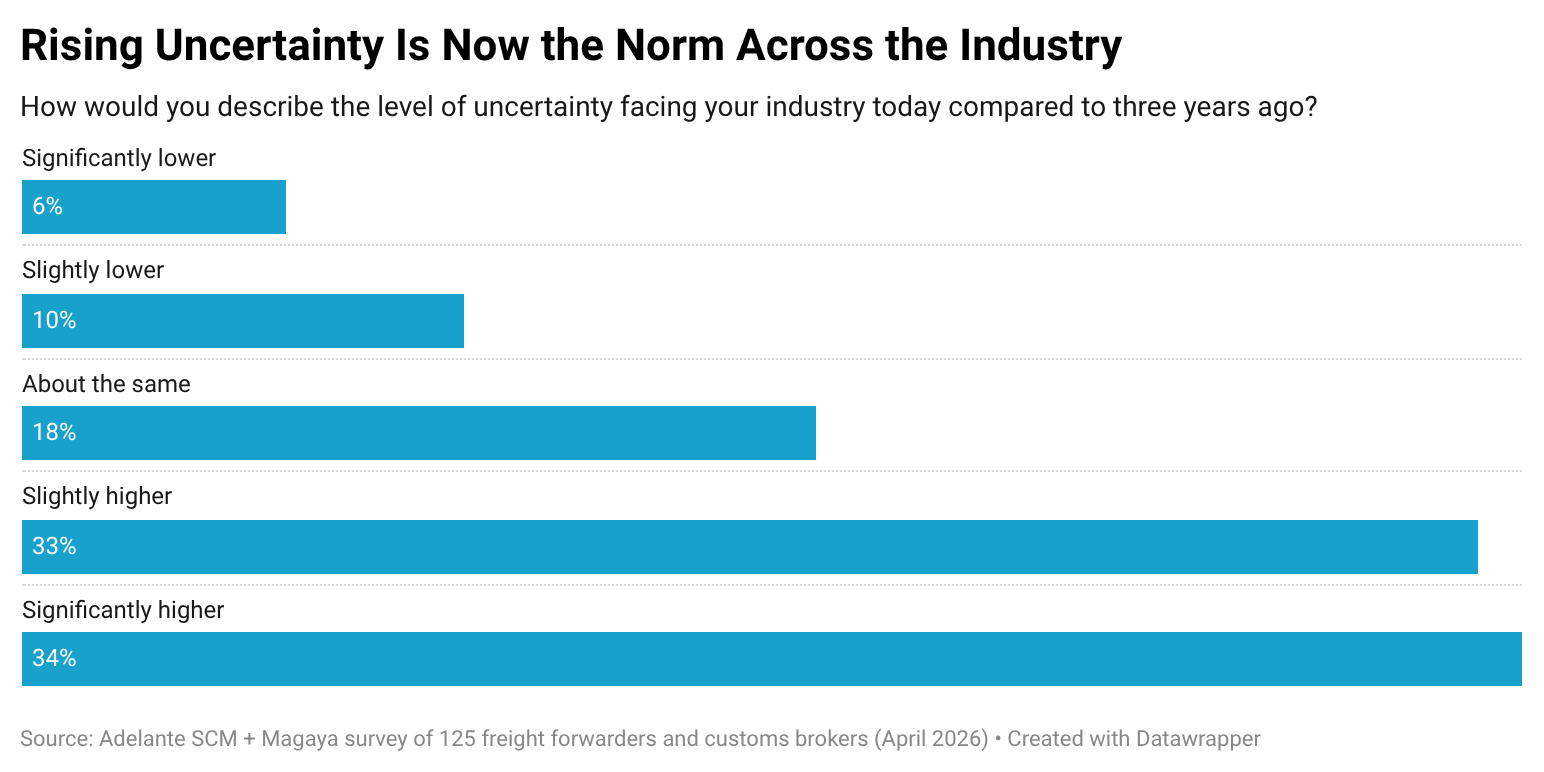
During my presentation, I asked the audience, “How many of you believe that uncertainty and volatility will decrease in the years ahead?” Only two or three hands went up.
The overwhelming majority believe that volatility and uncertainty are here to stay, driven by (among other things):
- Ongoing tariff and trade policy changes
- Heightened geopolitical risk
- Increasing regulatory complexity
- Accelerating technological change, particularly AI
The bottom line: the industry is becoming more dynamic and less predictable, requiring faster decision-making, greater operational flexibility, and better access to timely, trustworthy data.
The problem, as the survey further revealed, is that many freight forwarders and customs brokers are not capable of operating effectively in this kind of volatile environment due to fragmented data, manual processes, slow decision cycles, and limited integration across partners. More on this topic in the upcoming research report.
A final thought, based on my interviews with executives at the conference: The leaders are not asking, “How do we manage through this volatility?” They’re asking a more strategic question: “How do we turn volatility into an advantage?”
AI at Inflection Point
Of course, AI was a hot topic of conversation at the conference, with multiple sessions on it.
On the products front, Magaya launched ACEbridge AI compliance agent, “an AI-powered solution that gives customs brokers, freight forwarders, and trade compliance teams access to citation-backed regulatory guidance directly within their existing workflows.” Here are more details from the press release:
Purpose-built for U.S. trade compliance, ACEbridge provides instant, reliable answers grounded exclusively in official CBP sources. Whether users need filing guidance, error resolution, or the latest agency announcements, the solution helps them move faster and reduce risk without switching between systems.
Every response is backed by source citations, and when information falls outside the knowledge base, the system clearly indicates it, so users always know where they stand.
On the research front, the survey results show that we’re at an inflection point in the industry, with most companies evaluating or piloting AI capabilities — but only a tiny percentage have scaled it across their operations.
Simply put, there is plenty of optimism about AI, but it is also a key contributor to the uncertainty and volatility in the industry — especially when it comes to its impact on the workforce.
Some companies, across all industries, are asking, “Where can we replace people with AI?”
Others are asking, “Where can we make people more effective with AI?”
It’s short-term vs. long-term thinking — quick returns vs. sustained value. Which camp do you fall in? And which question do you believe the leaders are asking?
Final Thoughts
Many of the executives I interviewed at the conference were from small and midsize freight forwarders and customs brokers. For them, the technology they use from Magaya helps level the playing field against much larger competitors.
So, what becomes the real competitive advantage?
Delivering a better overall customer experience — faster responses, greater transparency, proactive communication, and more personalized service. In other words, not just moving freight, but delivering on customer expectations better than anyone else.
Technology may help level the playing field, but in the end, leadership will belong to the companies that combine technology with execution, adaptability, and customer trust.
Congrats to the Magaya team on 25 years of success and for organizing an informative, productive, and fun conference. I’m already looking forward to next year’s event.