

Editor’s Note: The following is an excerpt from the recently published research report “Plan. Adapt. Repeat: The Next Chapter of Transportation Planning.” Conducted by Adelante SCM in partnership with Transporeon, the research surveyed 42 supply chain and logistics executives from manufacturing, retail, and distribution companies to understand how they are managing transportation planning today, the factors driving greater complexity, where current processes and technologies are falling short, and how automation and AI could enable more dynamic and responsive planning in the years ahead. To access the complete findings, download the full report.
Transportation planning has become increasingly complex and dynamic. Shippers must balance cost, service, asset utilization, and responsiveness, often while dealing with fragmented data, shifting demand, and real-time disruptions.
The results of our research reveal an industry in transition. Many companies have invested in transportation management systems and optimization tools, yet manual processes remain deeply embedded in daily planning activities. At the same time, respondents see automation and AI augmenting planners by helping them work faster, manage exceptions more effectively, and make better decisions.
Transportation Planning Remains a Hybrid Process
When asked which method best describes their primary approach to daily transportation planning, the most common response was an enterprise TMS with advanced optimization functionality, selected by 29% of respondents.
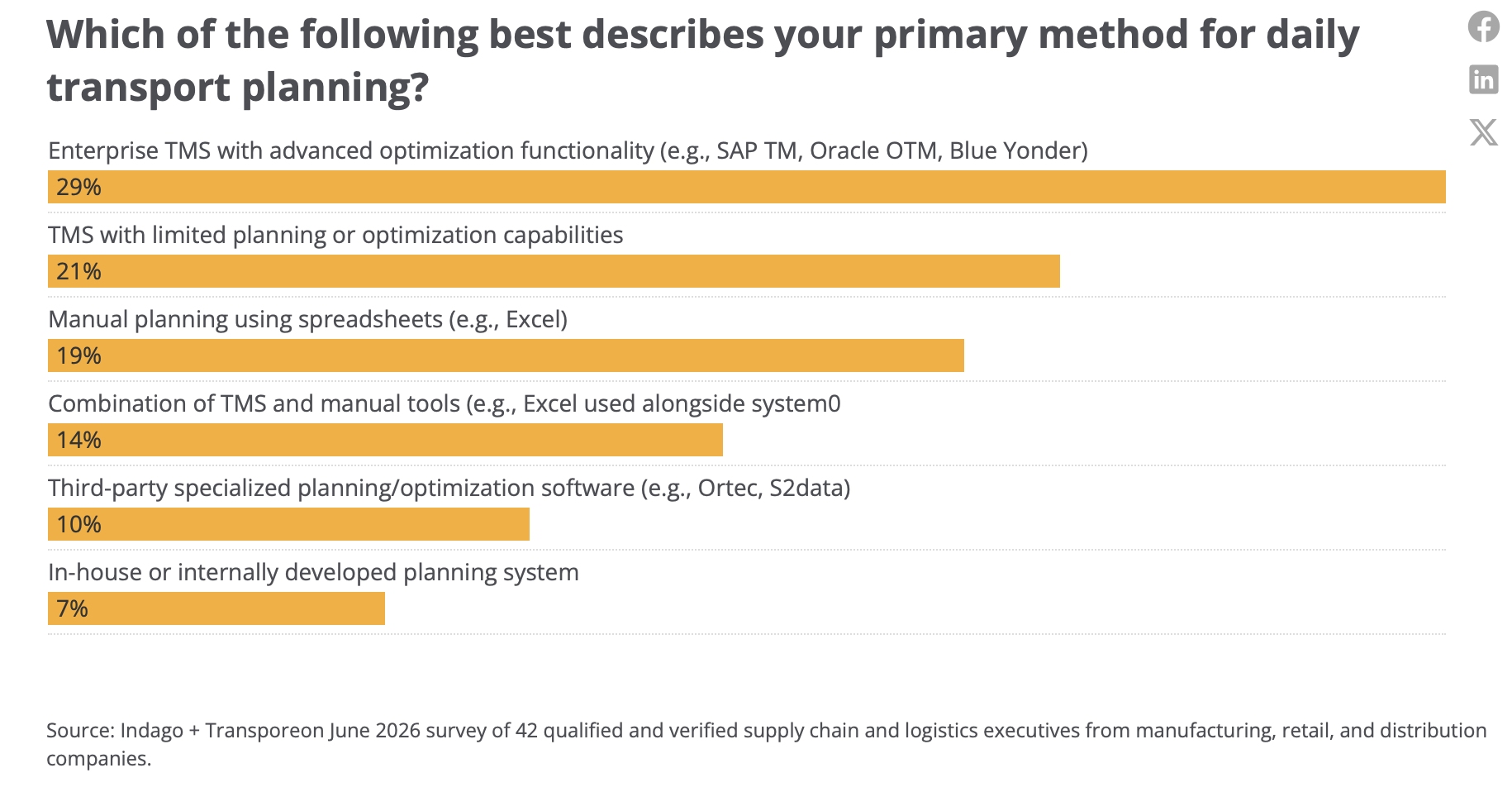
However, the broader picture is more mixed. While enterprise TMS platforms are the most common planning approach, many organizations continue to rely on spreadsheets, TMS platforms with limited planning capabilities, or a combination of system-generated plans and manual tools. The result is a hybrid planning environment where technology supports the planning process, but manual intervention remains common.
This finding helps explain many of the challenges highlighted elsewhere in the survey. When planners work across multiple systems, supplement TMS functionality with spreadsheets, or rely on manual workarounds, planning becomes harder to scale, standardize, and adapt as conditions change.
The results suggest that simply having a TMS is not enough. Organizations also need planning solutions with the functionality, integration, usability, and flexibility to support day-to-day operations.
For additional insights from the research, including what’s driving transportation planning complexity, where the biggest capability gaps exist, and how automation and AI could reshape transportation planning, please download the full report.