

Editor’s Note: The following is an excerpt of a research report published recently, “The Future of AI in Logistics.” The research, conducted by Adelante SCM and commissioned by Uber Freight, explores the current state and future direction of AI in logistics. The report includes data and insights from a survey conducted in April 2025 with members of the Indago supply chain research community and Uber Freight customers (a total of 90 qualified and verified supply chain and logistics executives from manufacturing, retail, and distribution companies). Please download the full report for all the research results.
“The future is already here — it’s just not evenly distributed.”
That quote by fiction writer William Gibson nicely summarizes the current state of Artificial Intelligence (AI) in logistics. It highlights two things that are simultaneously true:
- AI technology has actually been around for 50+ years, and has been used extensively in supply chain and logistics software applications. This includes the use of rule-based logic, basic machine learning, pattern recognition, and deterministic optimization capabilities.
- When it comes to newer forms of AI, such as Generative AI, Agentic AI, and Sequential Decision-Making, we are still in the early stages of market understanding and adoption.
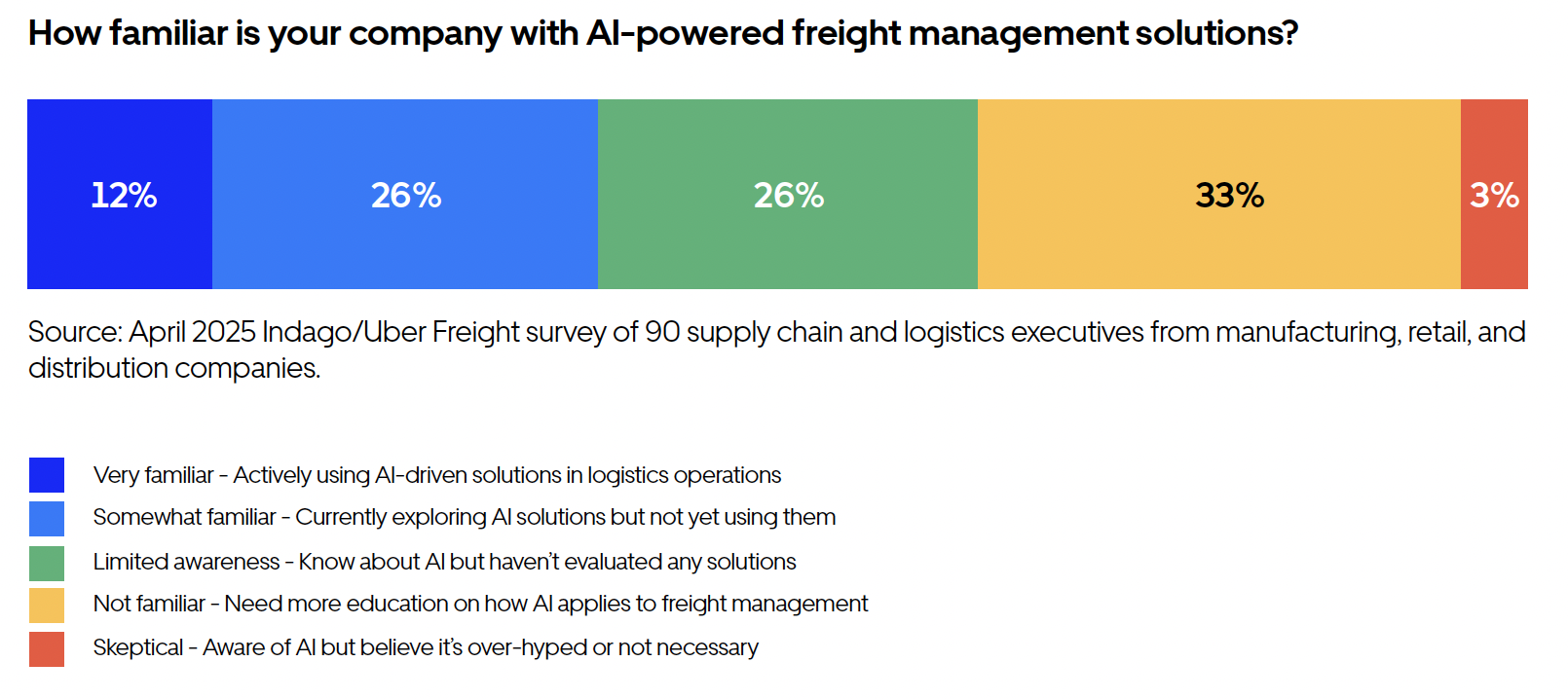
Put differently, companies that have implemented leading transportation management (TMS), warehouse management (WMS), and supply chain planning (SCP) solutions have been using AI for years, whether they know it or not. Yet, many of these same companies say they are either “Not familiar” or “Skeptical” of AI-powered freight management solutions, according to an April 2025 survey conducted with members of the Indago supply chain research community — who are all supply chain and logistics executives from manufacturing, retail, and distribution companies — and with Uber Freight’s customers.
As the chart below shows, only 12% of the respondents said they are “Very familiar” with AI-powered freight management solutions and using them. In contrast, more than a third of the respondents (36%) said they are either “Not familiar” or “Skeptical” of AI solutions.
“I have zero experience with AI in logistics and my current perspective is not very well informed,” commented one of the survey respondents, the Manager of Inbound Logistics at a multi-billion dollar company.
A Corporate Logistics Manager at another company said, “I currently have no experience to draw from to effectively [share my] perspective about AI in logistics. This would all be future investments for our company.”
Gibson’s point about the future not being evenly distributed is also evident in the survey results when you compare the responses of large shippers (those with greater than $1 billion in annual revenue) to small shippers (those with less than $100 million in annual revenue). The results show that large companies are much more familiar with AI-powered freight management solutions than small companies.
So, what is the current state of AI in logistics?
It is both well-established (when it comes to older forms of AI like deterministic optimization) and in the early adopter stage (when it comes to Generative AI, Agentic AI, and more recent innovations). It is also clear that much more market education is needed, especially with small companies.
Proof is in the Pudding: Demonstrable ROI and Cost Savings Would Accelerate Adoption of AI
As the saying goes, the proof is in the pudding, and the best way to overcome skepticism around the value of AI in logistics and accelerate its adoption is to demonstrate how it can actually deliver cost savings and a return on investment. This topped the list of factors that would accelerate AI adoption, selected by 64% of the respondents. It was followed by “Easier integration with existing tools and workflows” (57%) and “Proven case studies of AI success in logistics” (42%).
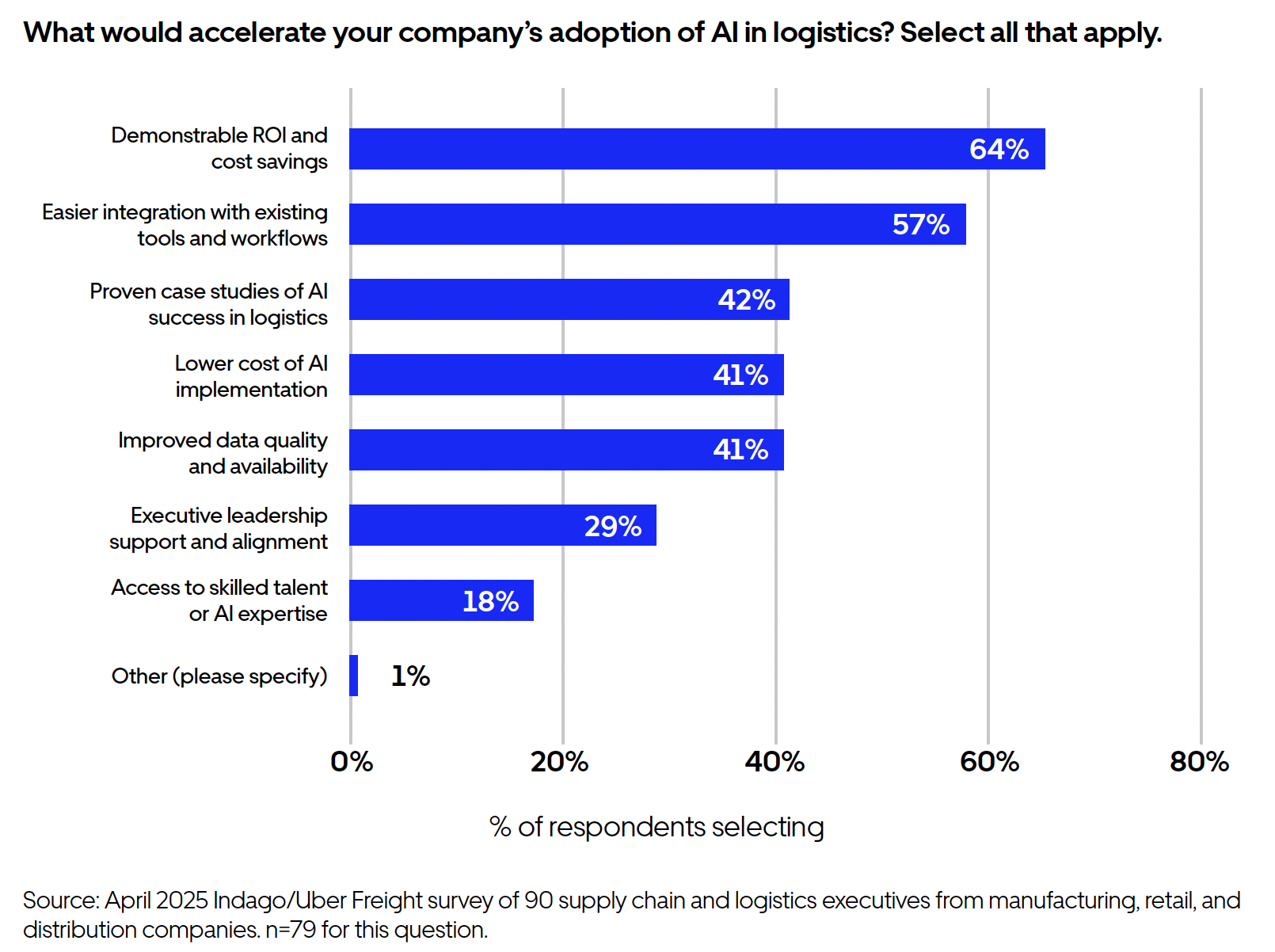
It’s interesting to note that “Lower cost of AI implementation” was fourth on the list (41%), tied with “Improved data quality and availability.” In short, the cost of AI-powered solutions is less of an issue/factor than expected.
—
What are the main drivers for companies to use AI in their logistics operations? Which AI-powered freight management solutions are companies most interested in using in the future? And how do industry executives see AI transforming their logistics operations over the next 5 years?
Those are the main questions explored in the “The Future of AI in Logistics” report, based on the survey referenced earlier with 90 supply chain and logistics executives from manufacturing, retail, and distribution companies. For additional insights from the research, please download the full report. Also, watch the recent Uber Freight Tech Talk where Adrian Gonzalez leads a conversation with panelists Chris Chmielewski, Shawn Piper, and Megan Lee on how AI is enabling change and innovation in the logistics industry.