

I was out of the office last Friday attending the 2006 USATF Outdoor National Championships with my oldest son, so I wasn’t able to write my regular “Above the Fold” post — my weekly roundup of supply chain and logistics news.
But I want to highlight two developments from last week because they relate to the two most consequential trends shaping the industry today: tariffs and AI.
The Trump Tariffs Strike Back
With apologies to George Lucas, allow me to make a Star Wars analogy here.
If the “Trade Wars” launched by Trump at the start of his second term were the first installment of a movie trilogy, ending with the Supreme Court’s decision earlier this year invalidating the administration’s tariffs under the International Emergency Economic Powers Act (IEEPA), then the second installment began last week with The Trump Tariffs Strike Back.
As Gavin Bade reported in The Wall Street Journal, the Trump administration is imposing tariffs “ranging from 10% to 12.5% on its major trading partners as part of a new set of duties that the Trump administration says are designed to combat forced labor.” Here are additional details from the article:
The new levies target 60 economies, or more than 80 countries, that [U.S. Trade Representative Jamieson] Greer’s office says represent about 99% of U.S. trade. Countries that have laws on the books to combat forced labor were given a 10% tariff, while those without such statutes were given a 12.5% tariff.
The new levies are based on a frequently used section of trade law — Section 301 of the Trade Act of 1974 — that is considered more legally durable than the basis for the tariffs the Supreme Court struck down. Once in place, the levies can remain indefinitely and be unilaterally altered by the president.
The immediate economic impacts of the tariffs are expected to be limited, as the new tariff rates are similar to the 10% global tariff that expires early Friday [July 24]. Even so, trade experts point out that there are a number of other tariff actions planned in the coming months that could further raise costs for businesses and consumers.
The tariffs announced last week are just the latest in a series of trade actions by the Trump administration. In recent weeks, the administration has also imposed new tariffs on certain Canadian imports, targeted certain Brazilian imports with additional duties, and levied new tariffs on specific copper products, while signaling that additional sector-specific tariffs — covering industries such as semiconductors, pharmaceuticals, timber, and other strategically important products — could follow as ongoing trade and national security investigations are completed.
Last December in “The Supreme Court, Tariffs, And The Turbulent Road Ahead,” I wrote the following (which was before the Supreme Court ruling on the IEEPA tariffs):
It’s important to note that a ruling against the Trump administration does not necessarily mean an end to the tariffs. It just means it can’t use the International Emergency Economic Powers Act (IEEPA) as a justification. But it can use other statutes that would be on more solid legal ground, such as Section 232 (for national-security reasons), Section 301 (to retaliate against unfair trade practices), and Section 201 (to stop import surges).
The truth is that regardless of what happens at the Supreme Court, tariffs ain’t going away in 2026 — and it may repeat as “Word of the Year” next year.
And so it happened. The trade war has entered its next chapter..
What should companies do now? A survey we conducted with Indago supply chain executives in November 2025 offers some useful guidance. Although the survey was conducted in response to the now-invalidated IEEPA tariffs, the findings remain highly relevant because today’s tariffs create many of the same sourcing and cost challenges.
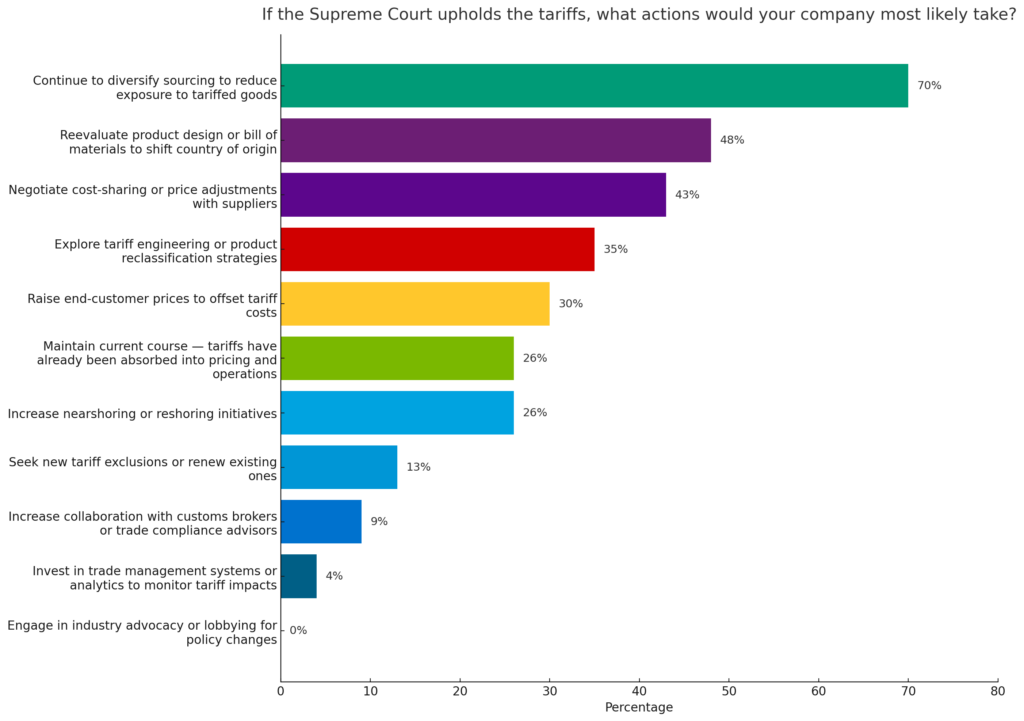
Seventy percent of respondents said they would continue diversifying their sourcing to reduce exposure to tariffed goods, followed by reevaluating product designs or bills of materials to shift the country of origin (48%) and negotiating cost-sharing or price adjustments with suppliers (43%). More tactical responses included exploring tariff engineering or product reclassification strategies (35%) and, as a last resort, raising prices for customers (30%).
In short, while the administration’s legal authority for imposing tariffs may have changed, the actions companies should take have not. Although many sourcing, manufacturing, and supplier decisions are costly and take time to implement, organizations that invest in greater flexibility today will be better positioned to respond as trade policies continue to evolve.
Will there eventually be a final chapter to this trilogy — The Return of Free Trade — that restores the predictability supply chain leaders need to make long-term sourcing, manufacturing, and investment decisions with confidence?
I’m out of time today, so tomorrow I will comment on the other news item that caught my attention, which raised the following question for me: Can we really trust and control AI?