

The opening keynote session at the recent Descartes Innovation Forum featured CEO Ed Ryan, President and COO Scott Pagan, and EVP of Product Management Ken Wood. In his remarks, Scott mentioned how all three of them started working at Descartes 25 years ago, which is a very long time in the software industry. It’s like dog years: 25 years at a supply chain software company is about 140 years elsewhere.
As I sat in the audience, I realized that my time covering Descartes as an industry analyst is even longer: 27 years. I’m not sure if the dog years math applies to analysts, but suffice it to say, I’ve been around a long time (longer than most industry analysts at the event).
I go back to the days when we were slapping the letter ‘e’ in front of everything: e-Business, e-Procurement, e-Commerce, e-Transportation, e-CRM, e-Learning, and the list goes on.
(Fun fact: Ed Ryan joined Descartes via its acquisition of E-Transport in February 2000.)
E-commerce stuck, but we thankfully dropped the prefix from everything else.
This is a long-winded way of me saying I have seen Descartes’ evolution from a company with a relatively small solution footprint that struggled financially after the dot-com bust (it was technically a ‘penny stock’ for a while in 2004) to a profitable and growing market leader with a diverse portfolio of solutions today.
When I started covering Descartes, the company was mainly a route planning and optimization company. What is Descartes today? A heck of a lot more, thanks largely to more than two decades of acquisitions. Here is how the company describes itself:
Descartes powers more responsive, efficient, secure and sustainable international and domestic supply chains by uniting logistics-intensive businesses on its Global Logistics Network (“GLN”). Shippers, carriers, and logistics service providers connect and collaborate on the GLN, leveraging technology, data and artificial intelligence (“AI”) to manage last mile deliveries, domestic and international shipments, transportation rating and payment, global trade research, customs compliance and a variety of regulatory processes.
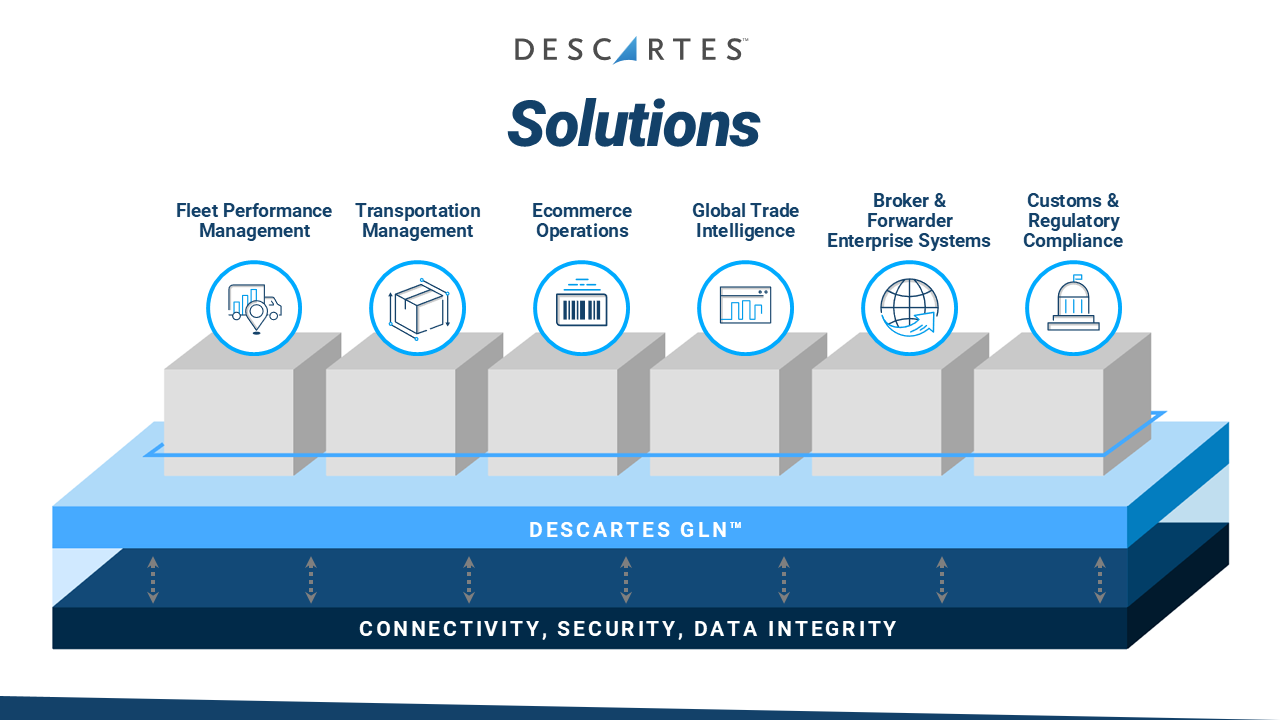
There’s a lot packed into that description, but this graphic provides a simpler overview of Descartes’ main solution categories:
So far this year, Descartes has acquired five companies:
- OrderMine (March 2026, $2.3M): AI-powered demand forecasting and planning for ecommerce
- Idelic (April 2026, $28M): AI-powered fleet safety and driver performance management
- Drivin (July 2026, $29.5M: Last-mile delivery optimization and execution in Latin America
- Tai Software (August 2026, $100M) AI-powered TMS for freight brokers
- Extensiv (September 2026, $120M) Warehouse management and omnichannel fulfillment for 3PLs
Other notable acquisitions in the past decade include MacroPoint (2017), Aljex (2018), BestTransport (2019), Kontainers (2020), MyCarrierPortal (2024), and 3GTMS (2025).
Collectively, these acquisitions have expanded Descartes’ footprint well beyond its transportation management roots. Today, its portfolio spans freight visibility, global trade compliance, freight brokerage, warehouse management, ecommerce fulfillment, fleet safety, and more. All of these acquisitions (more than 35 over the past decade) raise an important question: Is Descartes essentially a collection of acquired software companies, each with its own solutions and customer bases, or is it something more unified?
I think there’s some truth to both. And considering the diversity of Descartes’ customers — shippers, carriers (across all modes), logistics service providers, ecommerce retailers, freight forwarders, and customs brokers — it wouldn’t necessarily make sense to unify all of its applications into a single platform.
The more important question for me is how these different applications and capabilities can work together to address the specific needs of each customer. Some customers might need only a single application, such as a TMS or global trade compliance solution. Others might have much broader needs, spanning multiple supply chain and logistics processes, as well as geographies.
Descartes addressed this question with its biggest announcement at the Innovation Forum: the introduction of the Descartes Agent Control Plane (ACP). Simply put, Agent Control Plane is designed to enable AI agents to work together across different software applications and trading partners to complete tasks and coordinate activities that today require significant manual effort. The Descartes Global Logistics Network provides the connectivity and information needed to support these activities, while the Agent Control Plane coordinates the AI agents and helps build trust by ensuring they operate within customer-defined rules, policies, and approval processes, with human oversight where needed.
During the keynote, Descartes demonstrated how the Agent Control Plane could coordinate 28 steps across 15 Descartes applications and four companies, following the journey of a chair from the moment a customer ordered it online through final-mile delivery.
While there’s plenty of hype today about AI enabling autonomous supply chains, few companies (if any) are ready to fully delegate decision-making authority to AI agents. Autonomy doesn’t have to be all or nothing, however. As the Agent Control Plane demo illustrated, companies can determine which activities AI agents can handle autonomously and which require human approval, such as selecting a carrier or approving a product classification, based on their business requirements and risk tolerance.
In the press release, Descartes makes a point of mentioning that the Agent Control Plane not only helps its own AI agents coordinate work across applications and trading partners, but also makes “Descartes agents available within the AI platforms customers already use.”
Why is this noteworthy? Because just as companies today use software applications from different vendors, they will likely use AI agents from multiple providers too. By making its agents accessible through other AI platforms, Descartes aims to give customers greater flexibility in how they use its capabilities, rather than requiring them to operate exclusively within the Descartes environment.
It’s important to remember, however, that we’re still in the early stages of agentic AI adoption and deployment across the industry. While the Agent Control Plane demo illustrated what’s possible, the real test will be how well it works in everyday operations, particularly when coordinating activities across different applications and companies and when things don’t go according to plan (which is often).
We should learn more about that in the coming year based on the experiences of early adopters. Given how quickly things are moving, I’m willing to bet that instead of more demos, we’ll see actual customer case studies at next year’s Innovation Forum.
As for the rest of this year’s event — which was the company’s biggest ever, with more than 1,000 attendees, many of them first-timers — it was a busy three days of learning and networking. I moderated two panel discussions:
“Routing at Scale: Turning Complex Distribution into a Competitive Advantage” — Featuring executives from Williams Sonoma, HD Supply, White Cap, and SRS Distribution, we discussed how companies are improving routing performance, overcoming operational challenges, and using technology and data to improve efficiency and customer service. One takeaway, which I’ll explore in a future post or Talking Logistics episode, is the evolution of routing and optimization to Fleet Performance Management. In short, routing optimization is a continuous improvement process. You create a plan based on the realities of your operation, learn from what actually happens, and use those insights to make the next plan better.
“CEO Spotlight: Logistics Service Providers at a Crossroads” — I spoke with Chris Bachinski, Co-CEO and President at GHY International, and Gabriel Rodriguez, President at A Customs Brokerage, about how the LSP business is changing, the growing role of AI and automation, and how providers can differentiate themselves through technology, expertise, and customer service. A question we discussed that I’m still thinking about: As customer expectations and competitive pressures change, how does the LSP business model need to evolve?
I also participated in the panel discussion “Benchmark Survey, 10th Edition: A Decade of Change for Brokers and Forwarders.” I don’t want to steal the report’s thunder, but here’s one of my takeaways from the results: Trade policy volatility is a challenge for companies trying to manage their supply chains. But for forwarders and brokers, complexity can also create opportunity.
I’ll close with one final thought: 25 years ago, when everything was e-this and e-that, Descartes was in a tenuous position, especially financially. Today, when seemingly everything is branded as AI-powered, Descartes is in a much stronger position financially and strategically. The opportunity now is to build on that success as AI opens up new possibilities for the company and its customers.