
“Trust is the lubrication that makes it possible for organizations to work,” said Warren Bennis, the American scholar and consultant who pioneered leadership studies.
It is also the lubrication that makes supply chains work.
Unfortunately, headline after headline, poll after poll, shows that trust continues to decline across almost all aspects of society. “Gallup’s latest report [from July 2025] finds that just 28% of Americans have strong confidence in major U.S. institutions — near historic lows,” reported Benjamin Pacini at DeseretNews. Here’s an excerpt from the article:
Every year, major organizations — including Pew Research Center, Gallup, Edelman Trust Institute and the NORC Center for Public Affairs Research — release their polling information on institutional trust. What do the numbers say? In a moment of incongruous paradox, one of the few remaining things that unites Americans is our feeling of tribal distrust. Across political, generational and racial lines, Americans have lost faith in many of the systems we once relied on.
Trust has declined in precipitous and historic ways across nearly every sector of public life — Congress, the news, public health, higher education, even religion. If it feels like nobody trusts anything anymore, it’s because, increasingly, we don’t.
Supply chains suffer from this trust problem too. In a September 2021 survey we conducted with our Indago supply chain research community, 56% of the respondents — all supply chain and logistics executives from manufacturing, retail, and distribution companies — either agreed or strongly agreed with the statement “You can’t be too careful when dealing with people across your supply chain.”
Why does trust matter in supply chain management?
For starters, trust is foundational for collaborative relationships.
In their book ”Getting to We” — about how to negotiate agreements for highly collaborative relationships — Kate Vitasek and Jeanette Nyden write, “More and more, business success depends on strategic relationships built for an ever-dynamic and interconnected world that will endure long after ‘the deal is done.’ For many organizations, this ongoing relationship is as important as the deal itself.”
The book contains an entire chapter on trust, where the authors warn that “without a fair degree of trust, companies will simply not continue on their journey to We. A lack of trust sets a hurdle that is too high to jump” — a hurdle many companies continue to run into.
As I’ve highlighted in the past, trust has an impact on the bullwhip effect too, which results in mismatches in demand and supply and excess inventory. For details, check out the July 2020 research study titled, “Evaluating Trust, Trustworthiness and Bullwhip Effect: A Three-Echelon Supply Chain Interactive Experiment. The bottom line is that trust has tangible and measurable effects on supply chain management. There is a financial cost to the bullwhip effect (e.g., excess inventory, markdowns) and it impacts customer satisfaction too.
Trust is also critical for Environmental, Social, and Governance (ESG) compliance. As new ESG regulations such as Corporate Sustainability Reporting Directive (CSRD), Uyghur Forced Labor Prevention Act (UFLPA), and European Union Deforestation Regulation (EUDR) gain momentum globally, supply chain leaders are facing rising pressure to achieve end-to-end transparency and compliance across all supplier tiers.
Trust, ESG Compliance, and Supply Chain Operating Networks
I highlighted the link between trust and ESG compliance during my keynote presentation last month at Infor Nexus Connect 2025. I focused on this topic because it’s an area where Supply Chain Operating Networks, such as the Infor Nexus supply chain business network, are uniquely positioned to address. In fact, trade and regulatory compliance are part of our “Better With A Network” research initiative.
At the event, Infor provided an update on its ESG and supply chain traceability solutions, which includes NexTrace, a new solution announced in January 2025. As described in the press release, “NexTrace provides end-to-end transparency by seamlessly tracking raw material through to finished products and beyond, ensuring full traceability throughout the entire supply chain journey. It integrates supplier ESG data and certificates for a holistic view of sustainability and compliance information.”
Where does “the power of the network” come in? Per the press release: “By connecting to Infor Nexus, companies gain a head start [on collaborating across supply chain tiers], leveraging an established ecosystem of over 94,000 brands, retailers, and suppliers already on the platform. Managing traceability and chain-of-custody data alongside existing supply chain processes on a unified platform accelerates progress, boosts efficiency, and reduces reliance on multiple systems.”
Back to my keynote presentation: In preparation, we conducted a survey with members of our Indago supply chain community and asked them: If a trusted supply chain partner was found to have compliance or risk management issues, how would your organization most likely respond? What type of evidence do you require from trading partners for them to receive/retain “Trusted Partner” status?
First, while companies are tightening compliance requirements, most admit that their visibility into trading partner networks remains incomplete.
- 55% are somewhat confident — they have visibility into most partners, but gaps limit full trust
- 42% are not very confident — they lack visibility beyond direct suppliers and customers
- Only 3% are very confident — reporting full multi-tier visibility across all partners
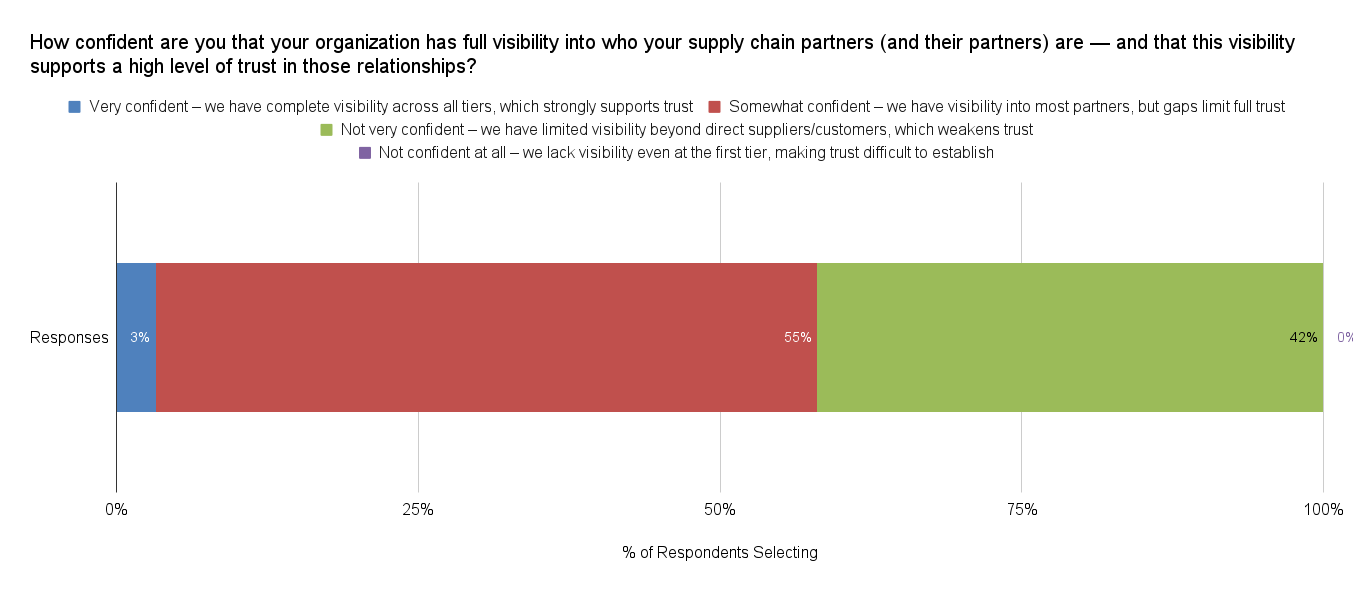
This visibility gap is a critical weak point. Without better traceability and monitoring beyond tier-1 partners, trust becomes difficult to verify and compliance risks remain hidden until a disruption or violation brings them to light.
When a trusted partner faces compliance or risk management issues, most organizations prefer remediation over termination.
- 42% said they would continue the relationship only if issues are corrected promptly and verified
- 19% would reduce the scope of the relationship until trust is restored
- Another 19% would maintain the relationship based on trust while working together to resolve the issues
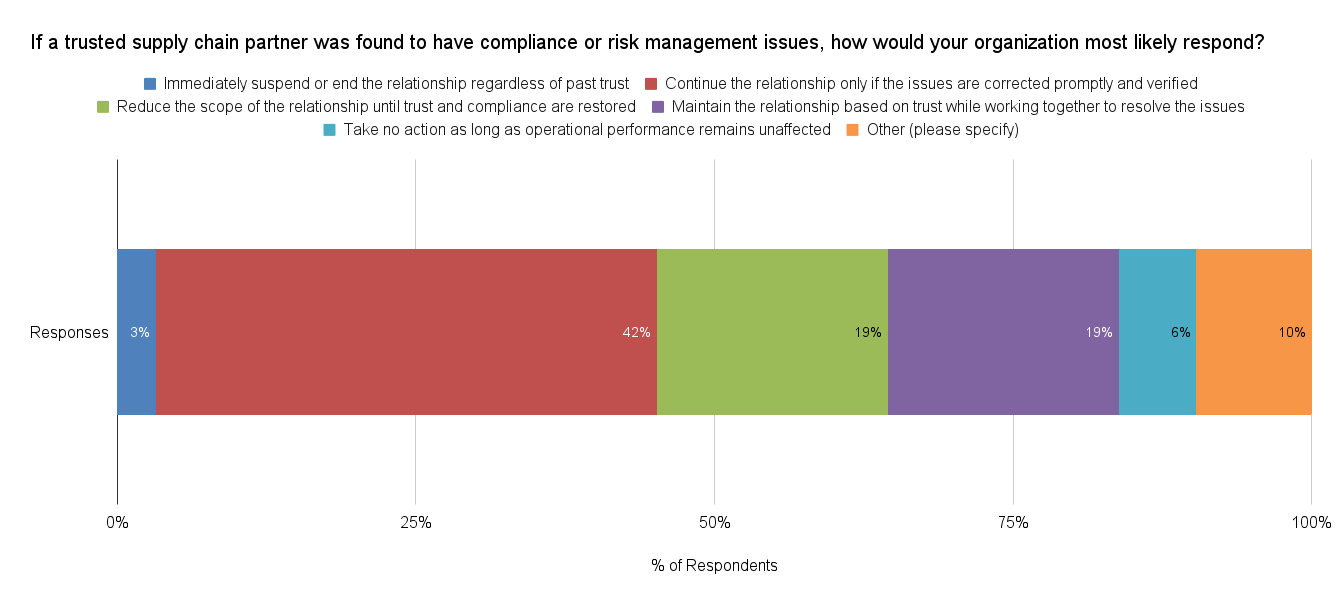
Only 3% of respondents would immediately suspend or end the relationship, while 6% said they would take no action as long as operational performance remains unaffected.
Respondents emphasized that regulatory or safety violations would trigger immediate escalation, regardless of prior trust:
“Immediate escalation would likely involve any regulatory or compliance issues identified by either our larger clients (those with compliance teams) or by government agencies, as these tend to have direct and measurable financial impacts. We expect all our partners to address such issues as soon as possible and to provide regular progress reports and updates over the first 30 days so we can demonstrate meaningful change if required by our client or the relevant agency.”
Others were more direct about what constitutes a red line: “Human safety or trafficking. Gross contamination of product.”
Even in those cases, the path to rebuilding trust begins with transparency and swift corrective action. As one respondent noted, “We require our trading partners to have an established code of conduct… and we work with our partner to ensure that any issues that arise are resolved in a timely manner.”
For additional insights from the research, Indago members can download the report.
Closing Thoughts
Trust in supply chain relationships is increasingly inseparable from ESG compliance. A partner’s ability to demonstrate responsible sourcing, ethical labor practices, and regulatory alignment has become tangible proof of their trustworthiness — and failures in ESG performance can quickly erode that trust and expose companies to financial and brand risk. This is why Supply Chain Operating Networks are becoming so important: by connecting all partners on a single platform with shared data, real-time visibility, and digital verification of compliance documents, they make trust scalable and continuously verifiable across every tier of the supply chain.