

Last week, I was a guest speaker at the 76th Annual Salzburg Memorial Lecture Program at the Martin J. Whitman School of Management at Syracuse University. My presentation was on “The State of AI in Transportation Management,” but I began by addressing three questions about AI technology that are in the air today:
- Are we heading toward an AI bubble?
- Is AI really eliminating jobs or just providing an excuse for layoffs?
- If all the promises of AI Agents in supply chain management come true, what will be left for us humans to do?
I addressed the last question in a recent post, “When AI Agents Run The Supply Chain,” so I won’t repeat myself here. But let me share some quick thoughts on the other two questions.
Are we heading toward an AI bubble?
I began my career as an industry analyst in the late 90s just as the dotcom bubble was building. There’s no doubt that what’s happening today with AI has a similar vibe.
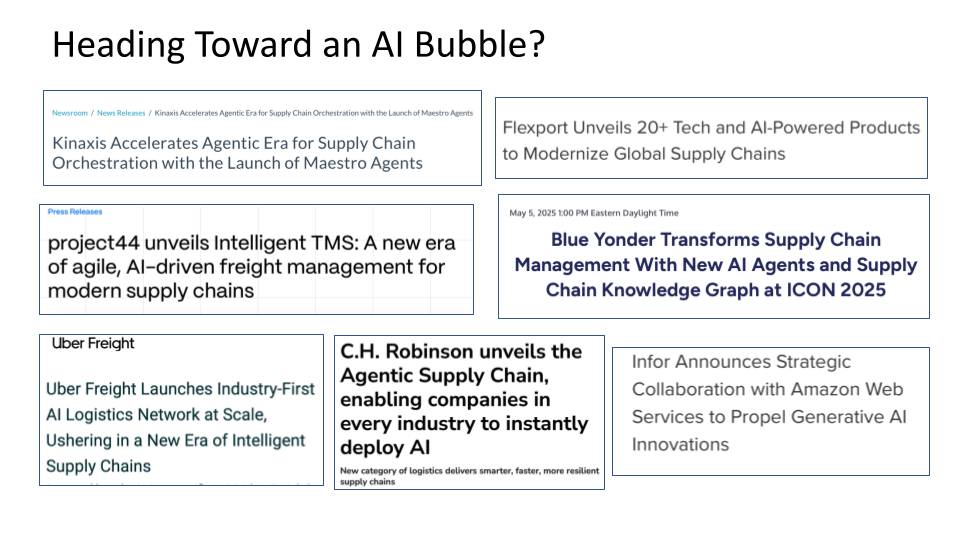
During the dotcom days, every technology company was slapping an “e-” (for “electronic”) in front of their solutions — e-business, e-procurement, e-transportation, e-everything. Today, every supply chain and logistics solution is being branded as “AI-powered” because you don’t want to be left out of the party. And the stream of press releases announcing new AI solutions is never ending. Here is a sampling from the past few months:
Then you have the crazy startup valuations.
“Cursor, a startup that makes an AI coding tool beloved by engineers, has raised $2.3 billion at a $29.3 billion valuation — nearly 12 times the value the company had in January,” reported Angel Au-Yeung in the Wall Street Journal last week. “Cursor was co-founded by four Massachusetts Institute of Technology graduates who are all still in their mid-20s.”
Maybe Cursor and similar startups are worth it, maybe not.
(For the record, my oldest son is a computer science engineer at a leading financial institution and I asked him about Cursor. “Yeah, it’s pretty good,” he said. “Very good for helping understand code. That’s the tool that my interns used to write their project with.”)
I have no doubt that history will repeat itself. There is an AI bubble, it will burst, and the surviving solutions will be those that deliver sustained and differentiated business value — which may mean pivoting to something different, just like the transportation marketplaces and exchanges during the dotcom era that evolved into software-as-a-service transportation management systems. And just like everyone eventually dropped the “e-” prefix — e-business just became business again — so will everyone drop the AI-powered reference too.
Is AI eliminating jobs or just providing an excuse for layoffs?
This question was inspired by two competing headlines just days apart:
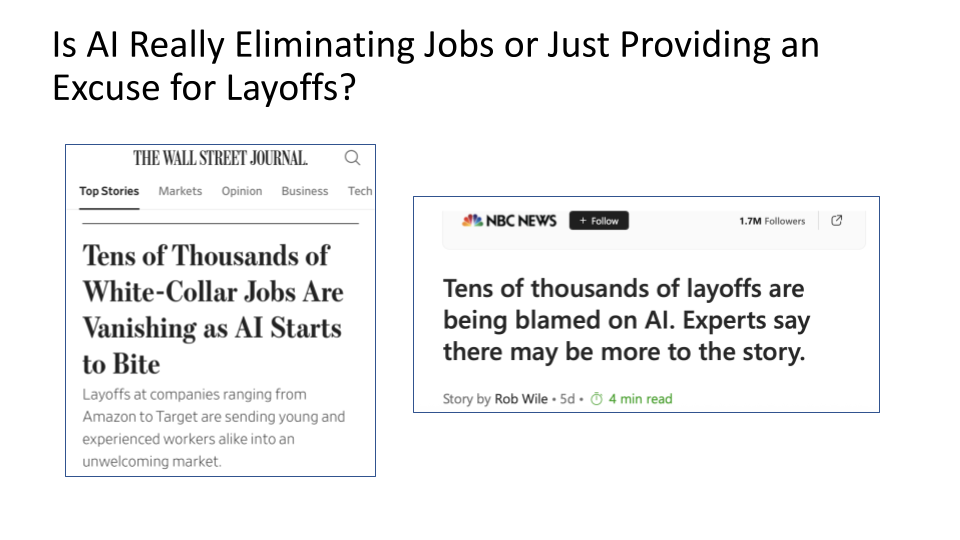
In an October 28, 2025 article in the Wall Street Journal — “Tens of Thousands of White-Collar Jobs Are Disappearing as AI Starts to Bite” — the authors reported how Amazon, Target, and UPS were laying off thousands of workers. “Behind the wave of white-collar layoffs, in part, is the embrace by companies of artificial intelligence, which executives hope can handle more of the work that well-compensated white-collar workers have been doing. Investors have pushed the C-suite to work more efficiently with fewer employees.”
Two days later, NBC News published an article originally titled, “Tens of thousands of layoffs are being blamed on AI. Experts say there may be more to the story.” It was an obvious response to the WSJ article. Here’s an excerpt:
Some of the largest companies in America have begun capping or reducing their head counts, blaming the promise of productivity with artificial intelligence for their decisions.
Yet, so far, there is uneven evidence that the promised cost savings from AI are actually worth what companies are putting into it.
This leaves some experts questioning whether AI could be serving as a fig leaf for companies that are laying off employees for old-fashioned reasons, such as financial underperformance or global economic uncertainty.
So, what’s really happening? Is AI killing jobs or are companies just using it as an excuse to lay off employees in response to tariffs, inflation, and other economic headwinds?
At this moment, the truth is probably a hybrid of the two. Companies are laying people off today to cut costs and meet their short-term financial objectives, with the hope that AI will eventually (hopefully sooner rather than later) deliver the promised productivity benefits that will enable them to “do more with less” moving forward.
Longer term, however, there is no doubt that AI will eliminate many jobs — either existing ones (resulting in layoffs) or ones that companies will no longer look to fill (resulting in more people competing for a smaller number of open positions). Those that say otherwise are simply lying (see “Three Lies We Tell Ourselves in Supply Chain Management”).
Of course, AI will create some new jobs too, but at this point, nobody knows for sure what the future of work will look like in 5 years. We’ll just have to wait and see.
Those are my two (non-ChatGPT generated) cents on those questions. What about you? Do you believe we are in an AI bubble? Is AI causing layoffs today or is it being used as a scapegoat by companies to cut costs quickly? Post a comment and share your perspective.