

Editor’s Note: The following is an excerpt from “Transportation Pulse Report 2026 – Smarter. Faster. Still Human. The AI Shift in Transportation Management.” The research, conducted by Adelante SCM in collaboration with Transporeon, explores how shippers and carriers are using AI today, the obstacles they face, the opportunities they see ahead, and how they expect to interact with an AI-enabled TMS in the future. The report features data and insights from a survey of more than 230 supply chain and logistics executives across the U.S. and Europe, along with perspectives from industry leaders interviewed at Transporeon Summit 2025, including ArcelorMittal Steel, ASICS, Shell, Fercam, Hegelmann, Rail-Flow, and Peripass, among others. For more information and to download the full report, please visit the report page.
If AI adoption in transportation management were a marathon, most industry stakeholders would still be at the starting line. While some have taken their first steps, the real journey is just beginning.
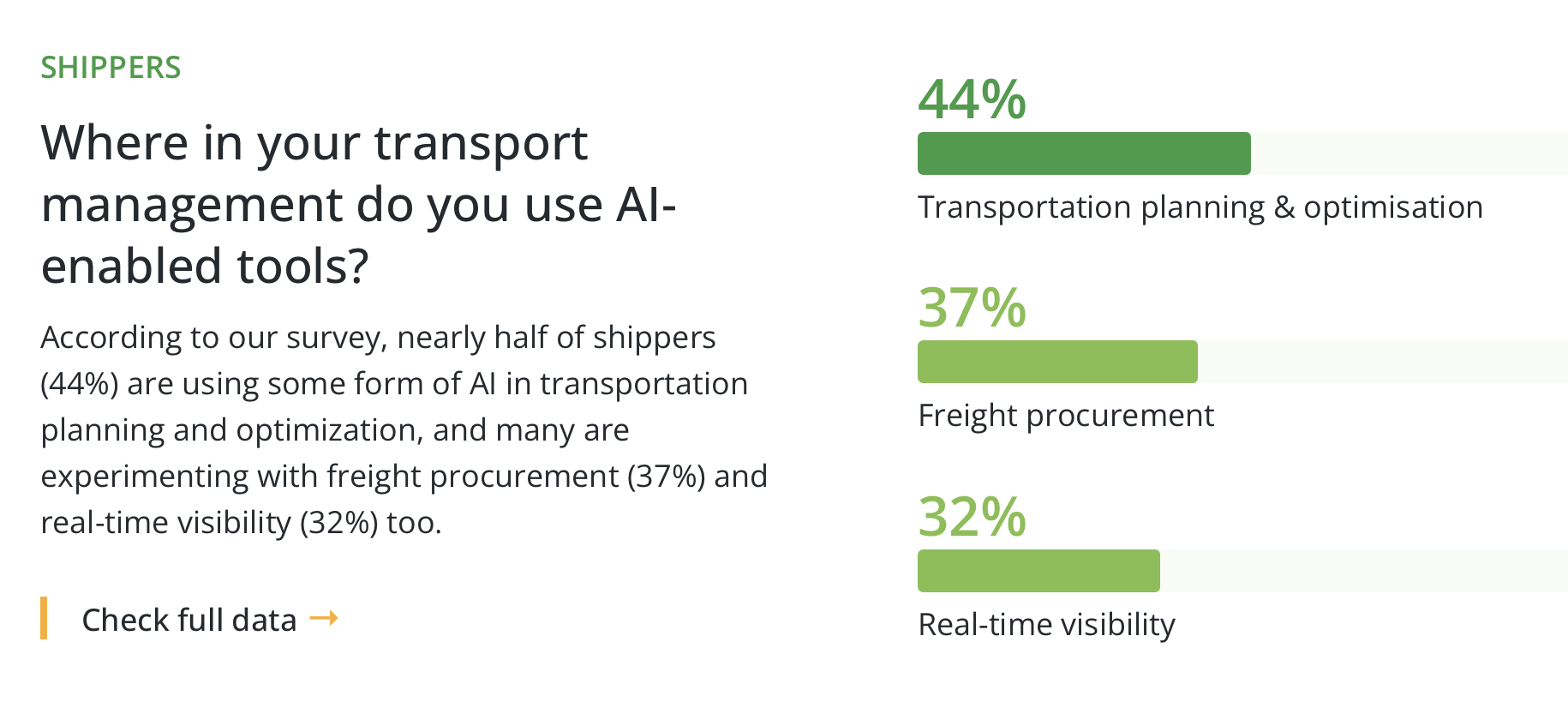
Where are shippers and carriers using AI-enabled tools in transport management?
According to our survey, nearly half of shippers (44%) are using some form of AI in transportation planning and optimization, and many are experimenting with freight procurement (37%) and real-time visibility (32%) too.
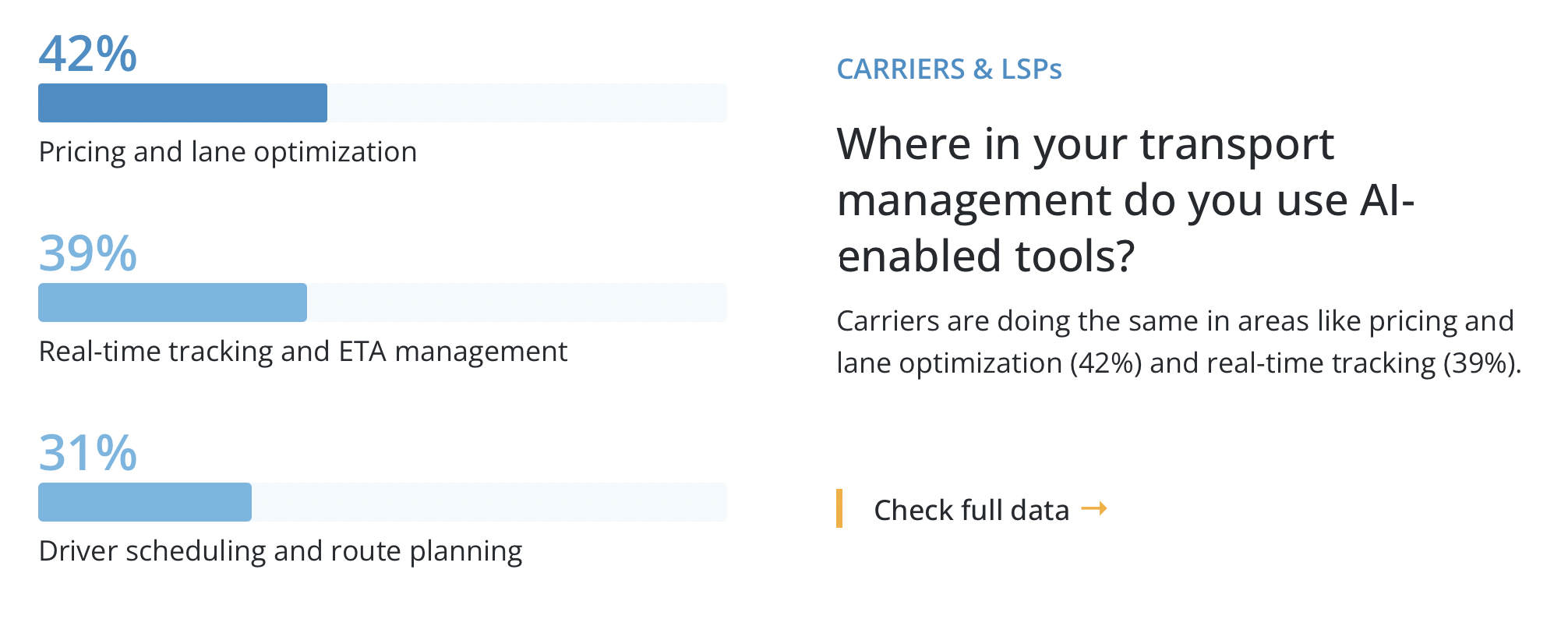
Carriers are doing the same in areas like pricing and lane optimization (42%) and real-time tracking (39%).
Yet adoption of AI remains low. While 36% of shippers reported having moderate or basic AI capabilities in their TMS, about 25% said they’re not using AI at all, and about 18% don’t even have a TMS. Among those that do, only a small fraction (1%) report advanced capabilities such as autonomous decision-making. Most still rely on basic, rules-based automation.
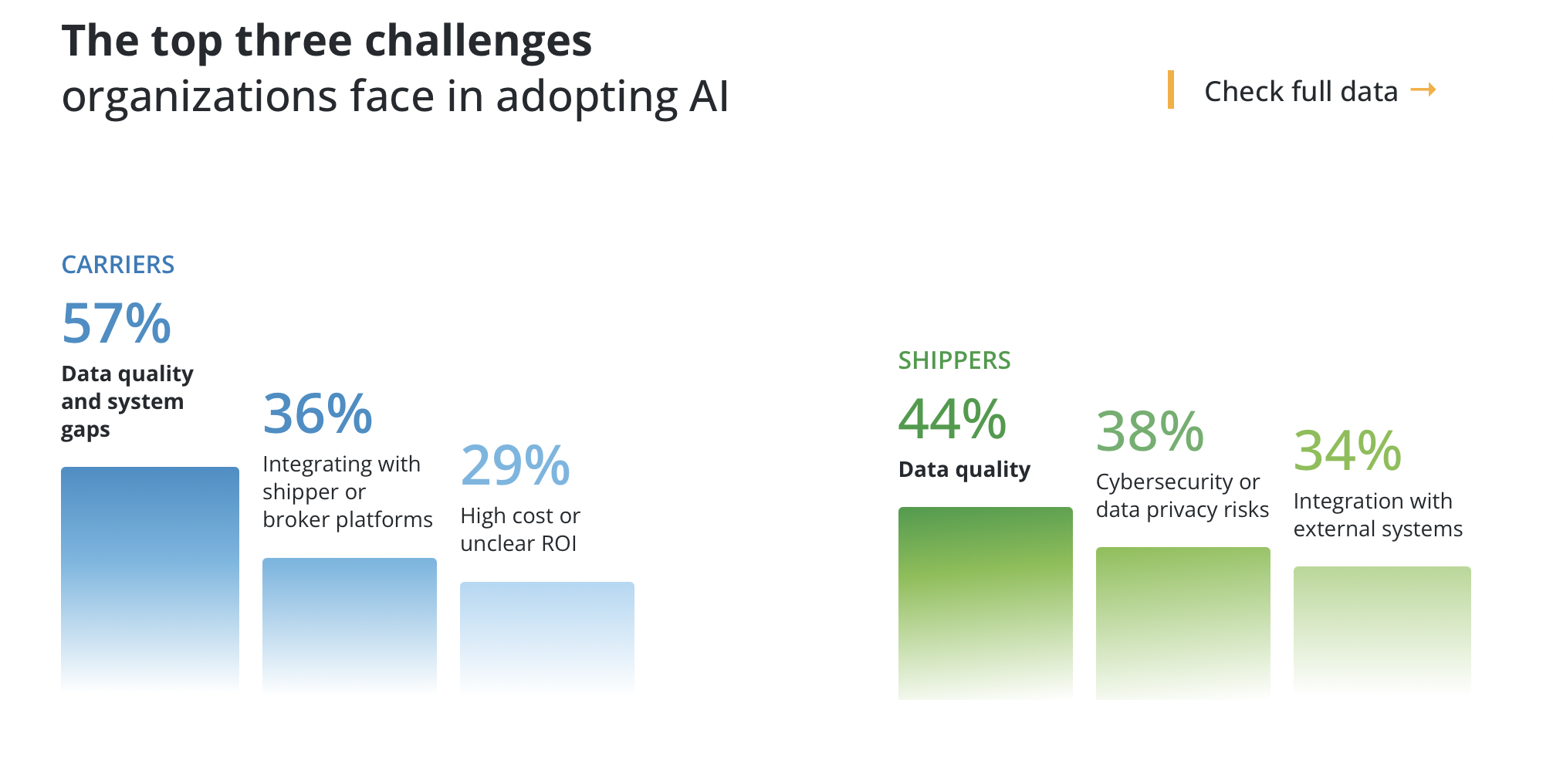
Even for those investing in AI, progress is slowed by a familiar obstacle: data quality. More than half of both shippers and carriers cite poor or inconsistent data as the biggest barrier to success. Integration issues compound the problem, as many struggle to connect internal systems and external partners. AI models can’t make accurate predictions when the data feeding them is incomplete, delayed or siloed.
Suzanne Bassermann of ASICS Europe, Tulio Freitas of Knauf, and Yvo Van Werde of ArcelorMittal, speaking at Transporeon Summit, underscored the reality that AI transformation begins with clean, consistent, and trusted data (watch the short video below for their comments). All the three converge on the same conclusion: you can’t build intelligent systems on poor data.
“AI forces you to improve data quality,” said Yvo Van Werde of ArcelorMittal. “The speed of change today is so fast that if you can’t react quickly with good data and tools, you’ll react too late. That’s why I see AI not just as a technology project, but as a change-management project, one that improves your processes, your communication, your decisions, and your speed.
Simply put, transportation leaders must view data readiness and system modernization as strategic priorities.Those who invest now in cleaning, integrating, and enriching their data will move faster toward autonomy, while everyone else risks running the AI marathon dragging years of data neglect behind them.
For additional insights and advice from the research, including the steps companies are taking to increase their efficiency, better serve customers, and gain a competitive advantage with AI solutions, please download the research report.