

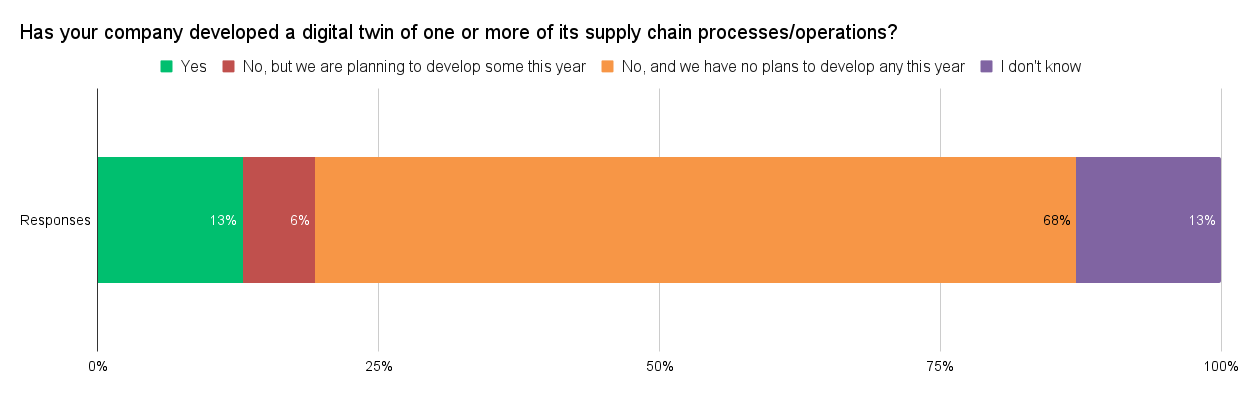
Has your company developed a digital twin of one or more of its supply chain processes or operations?
We asked members of our Indago supply chain research community that question in February 2020 — almost five years ago, and just before supply chains came to a halt due to the COVID pandemic. At the time, 74% of respondents — supply chain and logistics executives from manufacturing, retail, and distribution companies — said they were not using supply chain digital twins (see report for full results).
“While [digital twins] sound like a great idea, it would be difficult to get the budgeted capital funds to get a project kicked off for this technology,” said one executive when asked about the challenges of getting started. Here’s what others said:
“I never really heard about [digital twins] until now, but I definitely think it’ll be something that most companies are going to try and implement.”
“I doubt the digital twin process will be of value to most middle-rung companies. For complex retail chains, I can see its value.”
“My organization is so far behind in supply chain technology that I don’t think most in the organization could get their heads around the concept.”
“This will require a few years of quantifiable data and successes, showing skeptics how the benefits are captured and translated into actionable improvements.”
I recalled this survey — and the comment about needing quantifiable data and successes — when I saw PepsiCo’s announcement last week that it had entered into “a multi-year collaboration with Siemens and NVIDIA to transform plant and supply chain operations through advanced digital twin technology and AI.” Here are some details from the press release:
PepsiCo and Siemens are digitally transforming select U.S. manufacturing and warehouse facilities by converting them into high-fidelity 3D digital twins that simulate plant operations and the end-to-end supply chain to establish a performance baseline. Within weeks, teams optimized and validated new configurations to boost capacity and throughput, giving PepsiCo a unified, real-time view of operations with flexibility to integrate AI-driven capabilities over time.
Leveraging Siemens’ Digital Twin Composer, NVIDIA Omniverse and computer vision, PepsiCo can now recreate every machine, conveyor, pallet route and operator path with physics-level accuracy, enabling AI agents to simulate, test, and refine system changes — identifying up to 90 percent of potential issues before any physical modifications occur. This approach has already delivered a 20 percent increase in throughput on initial deployment and is driving faster design cycles, nearly 100 percent design validation and 10 to 15 percent reductions in capital expenditure (Capex) by uncovering hidden capacity and validating investments in a virtual environment [emphasis mine].
If you were skeptical in the past about the value proposition of digital twins — and wanted quantifiable data to change your mind — there you have it.
Digital twins have been around for a long time. Even Google got in the game when it launched its Supply Chain Twin solution in September 2021 (the solution is no longer marketed as a standalone product; it’s been integrated into Google’s broader Cortex Framework and AI-powered industry solutions).
Compared to five years ago, however, companies today have far more data, greater computing power, and more advanced AI capabilities, making it possible to build more complex, higher-fidelity digital models of their supply chains. As PepsiCo has demonstrated, these advances can significantly magnify the business benefits achieved through smarter facility planning, layout design, and operational simulation (among other use cases).
To what extent is your organization using (or shifting toward) digital twins to support facility planning, layout design, and/or operational simulation? Where do you see the greatest potential value from using AI-enabled digital twins in your organization?
We’re asking our Indago members those questions and more in this week’s survey. Want to share your experience and perspective on this topic — and see how you compare with your peers? Join Indago today to take the short survey and receive the results. Members will receive the report next week.
Will the results differ much from five years ago? It all depends on whether what this Indago executive said back then has actually happened: “As company operations become more complex, digital twins become a ‘must have.’ Companies with simpler operating environments could delay implementing digital twins but will likely adopt them [in the future] due to increasing competition and operating standards.”
The question now isn’t whether digital twins deliver value, but how long companies can afford to operate without them.