

Editor’s Note: The following is an excerpt of a research report published recently, “Examining AI’s Role in Modernizing the Freight Procurement Process.” The research, conducted by Adelante SCM and commissioned by Trimble, explored the current state of freight procurement — how shippers source capacity, use data, and manage the end-to-end process from planning to award. Please download the full report for all the research results.
Freight procurement is evolving rapidly, shaped by digital innovation, rising complexity, and increasing pressure to improve cost, service, and agility. Yet many procurement teams still face time-consuming manual processes, limited visibility, and challenges accessing the data they need to make smart decisions.
In June 2025, we conducted a survey with members of the Indago supply chain research community, who are all supply chain and logistics executives from manufacturing, retail, and distribution companies, to better understand the current state of freight procurement — specifically, how shippers source capacity, use data, and manage the end-to-end process from planning to award.
A large percentage of the respondents (44%) described their freight procurement process as either “Mostly manual with some digital tools” (26%) or “Entirely manual” (18%). Another 41% said their processes are “A balanced mix of manual and automated steps.
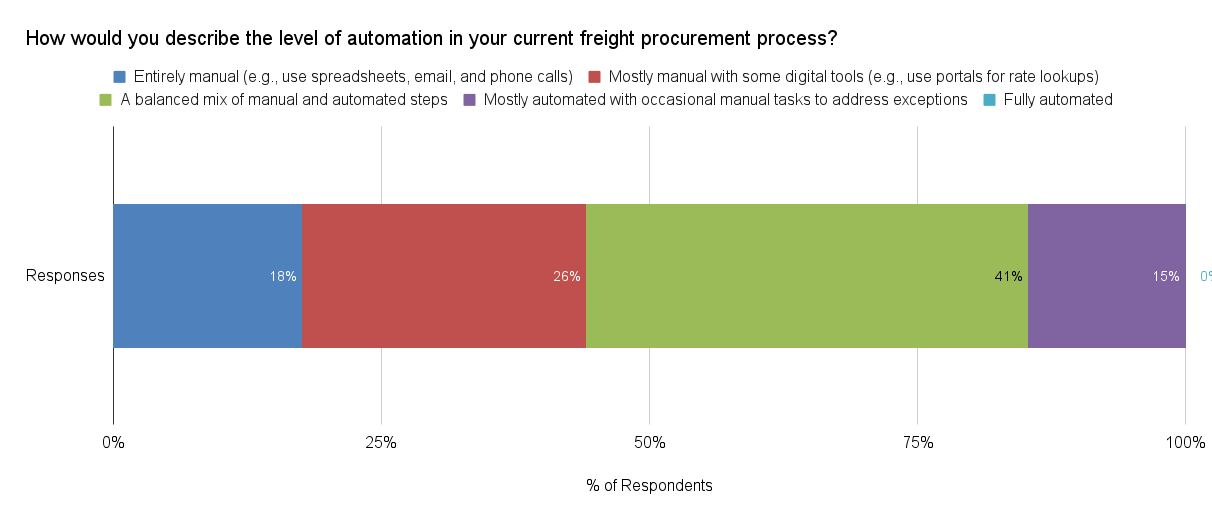
Clearly, there are still too many companies that rely on manual or mostly manual freight procurement processes, especially for getting internal stakeholder alignment and approvals, as well as with bid setup and RFP creation. As one supply chain executive commented, “Our processes are still manual; it’s hard to keep up with it.” Another said, “Our procurement process is mainly manual. It is very difficult for us to distinguish between carriers and brokers.”
This is surprising given that a September 2022 Indago survey revealed that 79% of member executives agreed they could no longer rely on spreadsheets to manage their transportation processes and needed to invest in new technologies, with 41% strongly agreeing. These results suggest that moving away from spreadsheets and manual processes has been slower than anticipated, at least when it comes to freight procurement.
We explored several other questions with our Indago members, including: Which areas of your logistics procurement process require the most manual effort today? To what extent do you use internal and external data in your freight procurement decision-making? Which capabilities would most improve your procurement process? How confident are you in your current ability to forecast freight demand and market conditions?
For insights on those questions and more, please download the full research report.