

I was in the kitchen making my morning coffee this past Sunday when I heard my wife call from the basement: “Adrian, can you come down here? I think we have a problem.”
Not a great way to start the day.
It got worse when I went downstairs and saw a puddle of water around our water heater.
I called the plumber who installed it — less than six years ago — and left a message. Then I called again on Monday, Tuesday, and Wednesday. No response. This is a plumber we’ve used many times before, which is why I kept giving him the benefit of the doubt.
But eventually I got the message: either he doesn’t need my business, or he doesn’t value me as a returning customer.
Either way, I don’t understand why he couldn’t spare a minute to call me back.
It’s a pet peeve of mine — a lack of basic professionalism in returning a call or email, especially from someone you already have a relationship with.
A different plumber — recommended by a friend — is coming this morning to replace the water heater. And just like that, the small tax refund I received is gone.
I need more coffee.
—
Here’s the supply chain and logistics news that caught my attention this week:
- $5 Diesel is Crushing Truckers. It Will Soon Be Felt Across the Economy. (WSJ – sub. req’d)
- USPS seeks temporary 8% charge on Priority Mail and other products (ABC News)
- EU parliament approves key terms of US trade deal (Supply Chain Dive)
- Stellantis supplier dispute halts Mexico production, threatens Canada plant operations (CBT News)
- FedEx To Offer Faster Delivery with Launch of FedEx SameDay® Local
- How Amazon Is Bringing Fast Delivery to Rural America (WSJ – sub. req’d)
- Amazon acquires startup Rivr to test robots for ‘doorstep delivery’ (CNBC)
- Amazon buys Fauna Robotics, maker of the Sprout humanoid robot (ABC News)
- Cold-Storage Vacancies Hit 20-Year High (WSJ – sub. req’d)
- Swisslog expands pallet ASRS portfolio with the AgileStore 4-way shuttle for flexible, high density pallet storage
- Shippo expands Shippo Intelligence with new AI-powered insights and advanced shipping analytics
- Zipments Launches Embedded Trade Tools to Power the Next Generation of Logistics Providers
- ATA Truck Tonnage Index Surged 2.6% in February
- Ocado calls cops on rival at Stuttgart trade show (The Grocer)
Tariffs Exit Stage Left, Diesel Prices Enter the Spotlight
Tariffs are so yesterday, especially after the Supreme Court ruling invalidating the IEEPA tariffs. The headlines have shifted back to something more immediate: oil and diesel prices.
That said, tariffs haven’t gone away. The Trump administration is now looking to leverage Section 232 of the Trade Expansion Act of 1962 and Section 301 of the Trade Act of 1974 to impose new ones. But with the war in Iran continuing to disrupt the oil market, gasoline and diesel prices are climbing — and grabbing most of the attention.
“Long-haul trucker Miguel Caveda recently spent around $1,800 on diesel fuel during a week on the road, about 40% more than he typically paid before the Iran war began,” reported Jared Mitovich and Jeanne Whalen in the Wall Street Journal this week.
Here’s more from the article:
In the near-term, this type of fuel surge could knock many small truck drivers out of business, straining the available capacity for shipping the same quantity of goods, said Avery Vise, vice president of trucking with FTR Transportation Intelligence.
The surge also affects larger freight carriers, many of which can by contract pass along added costs to the companies whose goods they are moving. That still presents a financial risk, because companies often pay their freight bills around 30 to 60 days after shipments, while the carriers pay the higher costs upfront, Vise said.
If diesel prices remain elevated or volatile for the rest of 2026, what actions is your organization most likely to take to manage transportation costs?
We asked members of our Indago research community — supply chain and logistics executives from manufacturing, retail, and distribution companies — and provided them with the following response options:
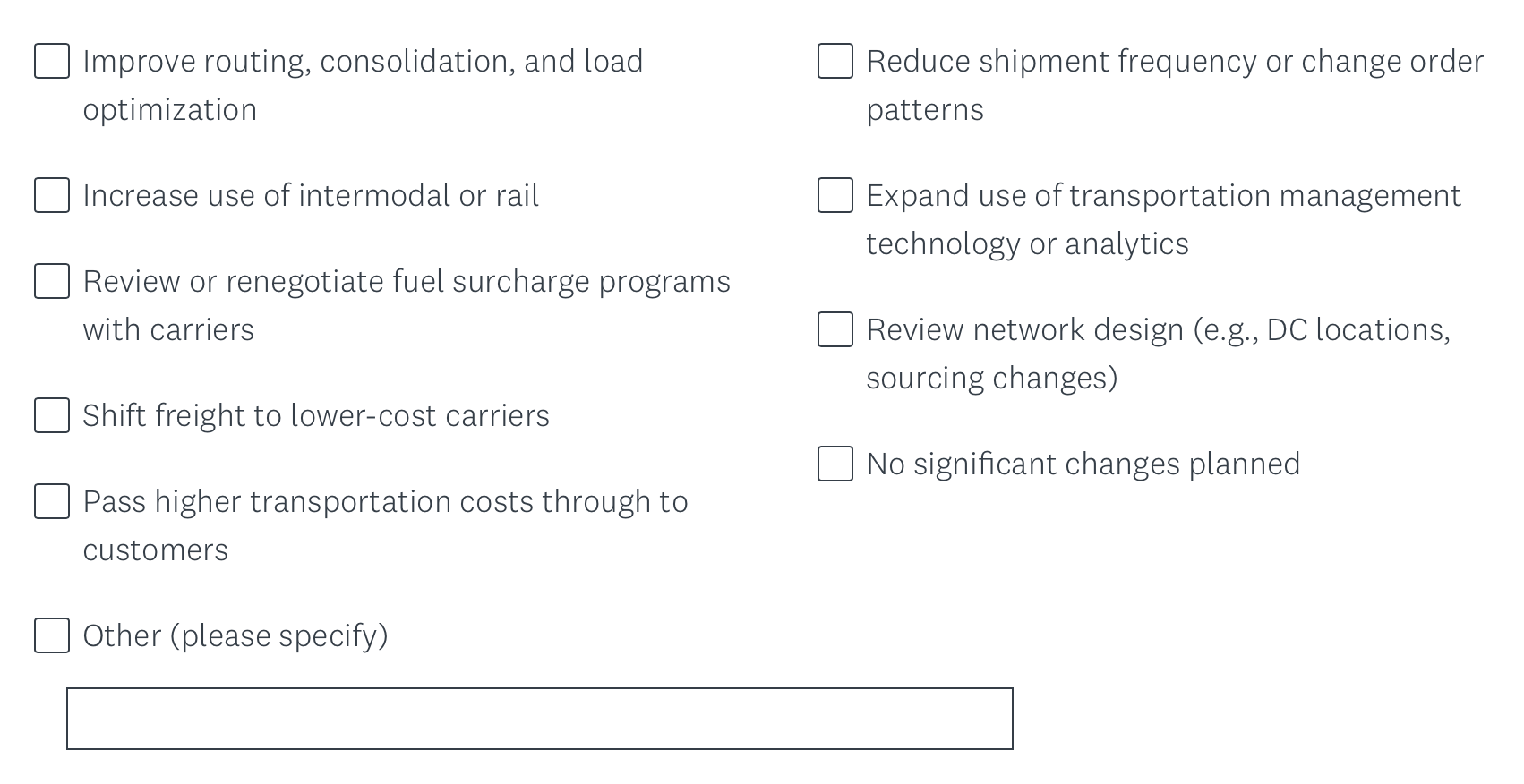
How would you have responded? And how do your peers compare?
Gaining these kinds of peer insights is a key benefit of being an Indago member. If you’re not a member yet, I encourage you to join our research community. Members will receive the full results of this survey on Monday.
The bottom line: nobody knows how long the war with Iran will continue or how high diesel prices will climb. But this is exactly the situation where preparation beats reaction. Companies that model scenarios now, define policies in advance, and move quickly when conditions change — instead of scrambling in the moment — will come out ahead.
And with that, I think the plumber is here.
Have a meaningful weekend!
Song of the Week: “undressed” by sombr